How to Stop Worrying About the Future When Everything Feels Uncertain
To stop worrying about the future, sort each worry into what you can influence and what you cannot, turn the controllable ones into specific if-then plans, and postpone the rest to a short daily worry window. Then take one small step today, because action shrinks uncertainty faster than thinking does.
What if I lose my job? What if the money runs out? What if the test results are bad? What if I make the wrong move and regret it for years? Worry about the future can make the present feel like a waiting room for disaster.
You cannot make the future certain. But you can stop it from taking over today. Here is a structured way to do it.
Why worrying about the future feels so convincing
Worry pretends to be helpful. It feels like you are preparing, protecting yourself, staying one step ahead. Sometimes that is true. More often, worry repeats the same scary scenarios without producing a single new plan.
Two features make future worry especially sticky:
- It is endless. There is always another "what if" behind the first one.
- It is vague. "Something bad will happen" cannot be solved because it has no shape.
The steps below give your worries a shape and a time limit.
Why telling yourself "don't worry" does not work
Trying to push worries away tends to backfire. In Wegner and colleagues' 1987 white bear experiments, people asked to suppress a thought later thought about it more. Telling yourself "stop worrying" is a form of suppression, which is why it often fails.
A better approach is to give worry a container, then turn the useful parts into action.
How to stop worrying about the future: 7 steps
1. Write every worry down
Spend five minutes listing every future worry on your mind, big and small. "Rent going up." "Kids' school next year." "My knee." "The economy."
Seeing them on paper often reveals two things: there are fewer than it felt like, and several are versions of the same fear.
2. Sort into three columns
Draw three columns and place each worry into one:
- I can act on this: there is something within my control.
- I can prepare for this: I cannot stop it, but I can reduce the impact.
- I cannot influence this: it is outside my control entirely.
The economy goes in column three. Your budget goes in column one. A possible layoff goes in column two.
3. Separate fact from fear for the top worry
Pick the worry that bothers you most. Write what you actually know as facts, then what you are predicting. "My company announced restructuring" is a fact. "I will be fired and never find work again" is a prediction stacked on a prediction.
Predictions deserve attention, but they are not news.
4. Turn column one and two into if-then plans
Gollwitzer (1999) reviewed research on implementation intentions, plans in the form "If situation X happens, then I will do Y." These specific plans were found to improve follow-through compared with general goals.
For future worries, they also provide calm. Your brain stops spinning on "what would I even do?" because you already know.
Examples:
- "If I am laid off, then I will apply to five roles that week and call two former colleagues."
- "If rent rises more than 10%, then I will compare three apartments within a month."
- "If I feel the knee pain again, then I will book a doctor's appointment that day."
5. Run a quick premortem on your biggest fear
Klein (2007) described the premortem: imagine a plan has already failed, then list the reasons why. Applied to worry, ask: "Imagine it is a year from now and this went badly. What most likely caused it?"
This usually surfaces two or three concrete risks you can address today, which turns a cloud of dread into a short to-do list.
6. Set a daily worry window
Borkovec and colleagues (1983) tested a stimulus control approach in which people postponed worries to a set 30-minute period in the same place each day. It reduced worry.
Choose a window, for example 15 to 30 minutes at 5:30 pm, not right before bed. When a future worry pops up during the day, jot it down and tell yourself, "I will think about that at 5:30." During the window, review the list. You will often find that worries that felt urgent at 11 am have shrunk.
7. Take one small step today
End every worry session with one action that takes under 15 minutes: update a resume line, check an account balance, send one email, book one appointment. Action creates evidence that you can cope, and evidence quiets worry better than reassurance.
Worked example: worrying about a job you might lose
Worry list: Layoffs at work, not being able to pay rent, having to move, what my family will think, the job market.
Sorting:
- Act on: savings plan, resume, network.
- Prepare for: possible layoff, possible move.
- Cannot influence: company decision, job market.
Fact vs fear: Fact: two departments were cut last month. Fear: "I am next, and I will be unemployed for a year."
If-then plans:
- If I hear my team is affected, then I will ask HR about severance terms the same day.
- If I am laid off, then I will apply to five roles in the first week.
Premortem: "If this went badly, it is likely because I had no savings buffer and an outdated resume." Both are fixable now.
Worry window: 6:00 to 6:20 pm daily.
Step today: Update the most recent job on my resume (10 minutes).
The future is still uncertain. But you now have a plan, a buffer in progress, and a time and place for the worry.
Copy-ready template: the future-worry planner
Copy this and fill it in once a week:
- All my future worries right now:
- I can act on:
- I can prepare for:
- I cannot influence (I will let these be):
- Top worry, facts only:
- Top worry, my predictions:
- If-then plan 1: If _, then I will _.
- If-then plan 2: If _, then I will _.
- Premortem: if this went badly, the likely causes are:
- My worry window (time and place):
- One step I will take today:
Worries that spike at night
Future worries often get louder in bed, when there is nothing to distract you. If that is your pattern, our article on why anxious thoughts get worse at night explains what is going on, and our brain dump before bed method shows how to park tomorrow's worries before sleep.
If your worry centers on a choice you need to make soon, see how to make big life decisions for a structured approach, and how to calm your mind from overthinking fast for in-the-moment resets.
How unLooper can help
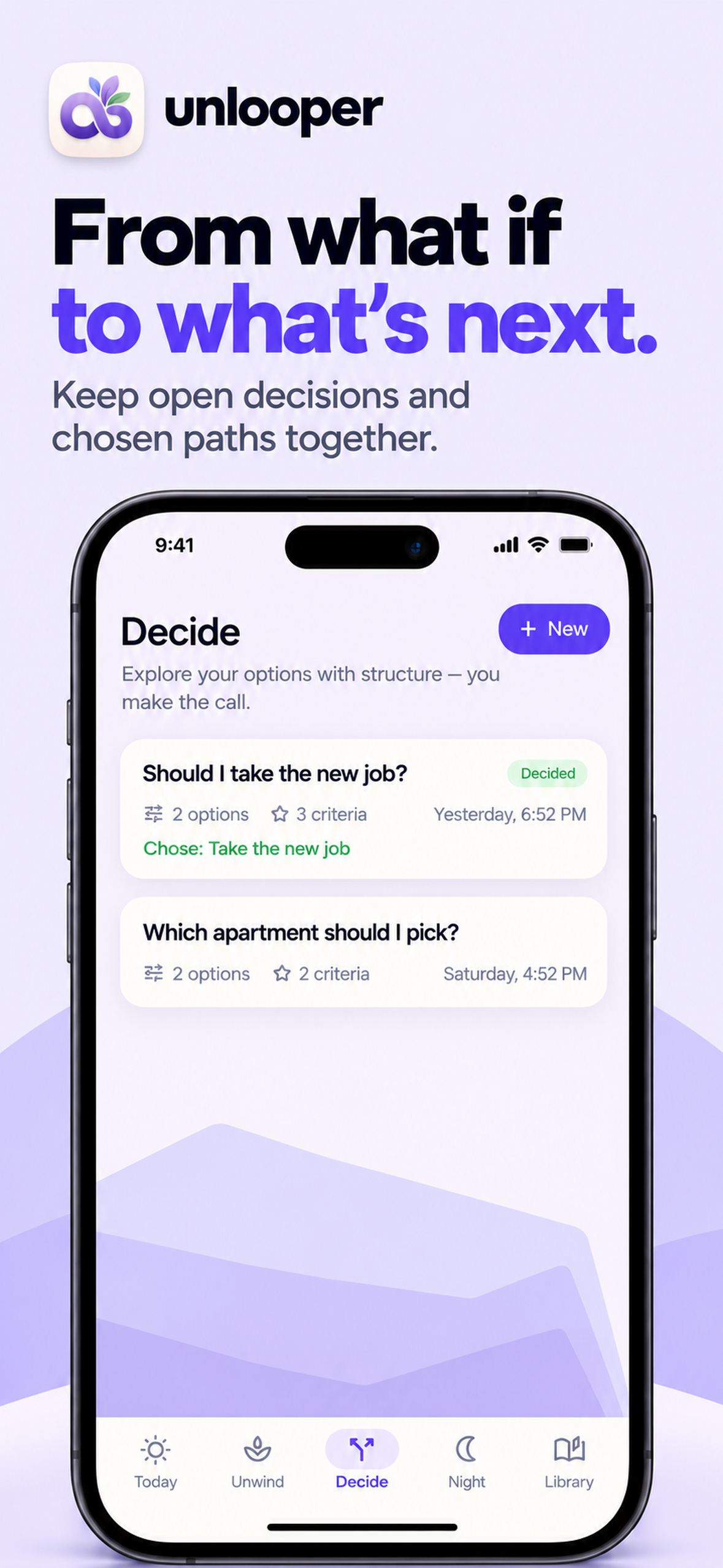
unLooper is a self-reflection app that turns worry into steps. The Overthinking Breaker is a guided session of about three minutes that separates fact from fear, helps you find other angles, and ends on one small doable step, the same arc as steps 3 to 7 here.
If your worries come at night, Quiet Mind at Night offers a bedtime brain-dump that sorts tomorrow's worries from tonight's, followed by breathing and grounding to wind down. And when a worry is really a decision in disguise, Decide for me helps you weigh options against what matters to you. Reflections stay on your device, with no ads.
When to get help
If worry about the future is persistent, disrupts your daily life or sleep, or comes with thoughts of self-harm, please talk to a doctor or licensed mental-health professional. In the US, you can call or text 988 to reach the Suicide & Crisis Lifeline.
The bottom line
You stop worrying about the future by giving it shape and limits: list it, sort it, plan for what you can, schedule the rest, and take one small step today. The future stays uncertain, but you no longer have to live in it.
Frequently asked questions
Why do I worry so much about the future?
Your brain is built to anticipate threats, and uncertainty feels like a threat. Worry can feel like preparation, but past a certain point it becomes repetitive thinking that does not produce new plans. Big transitions, money stress, and health concerns often make it louder.
Is it possible to stop worrying completely?
Probably not, and you would not want to. Some concern about the future helps you plan. The aim is to keep worry short and useful, turning it into plans, and to let go of the parts you cannot influence.
What is a worry window?
A worry window is a fixed daily time, often 15 to 30 minutes, when you allow yourself to worry on purpose. When worries pop up outside that time, you note them and postpone them. Research on this approach found it reduced worry.
How do I deal with fear of the unknown?
Make the unknown smaller. List what you actually know, what you can find out, and what nobody can know yet. Then plan for a few likely scenarios rather than every possible one, and focus on the next step.

Fahd Chouki is an independent developer and the founder of unLooper. He writes practical guides on overthinking, sleep and decision-making, summarizing published research into steps you can use the same day.
How we write: every guide is based on peer-reviewed research listed in the sources, reviewed for accuracy and updated when evidence changes.
Sources & further reading
- Borkovec, T. D., Wilkinson, L., Folensbee, R., & Lerman, C. (1983). Stimulus control applications to the treatment of worry. Behaviour Research and Therapy, 21(3), 247–251. doi:10.1016/0005-7967(83)90206-1
- Gollwitzer, P. M. (1999). Implementation intentions: Strong effects of simple plans. American Psychologist, 54(7), 493–503. doi:10.1037/0003-066X.54.7.493
- Klein, G. (2007). Performing a project premortem. Harvard Business Review, 85(9), 18–19.
- Wegner, D. M., Schneider, D. J., Carter, S. R., & White, T. L. (1987). Paradoxical effects of thought suppression. Journal of Personality and Social Psychology, 53(1), 5–13. doi:10.1037/0022-3514.53.1.5
This article is for general information and self-reflection. It is not medical advice and does not replace a doctor or licensed mental-health professional.