How to Stop Ruminating: What Research Says and 7 Techniques to Try
To stop ruminating, shift from abstract "why" questions to concrete "what happened and what can I do" questions, view the situation from a distance, and give the thinking a limited time slot. Research links rumination with longer distress and weaker problem solving, so ending each episode on a small action is key.
You replay the argument again. You think about what you should have said, why you reacted that way, what it says about you. An hour later you feel worse, and nothing has changed except your mood.
That's rumination, and it's one of the most common ways overthinking keeps people stuck. This guide explains what research has found about rumination and gives you seven practical techniques to step out of it.
What is rumination, exactly?
Rumination is repetitive, passive focus on your distress and its causes and consequences. It often looks backward ("Why did I do that?") or inward ("What's wrong with me?"). It feels like you're working on the problem, but you're mostly circling it.
Psychologist Susan Nolen-Hoeksema spent much of her career studying this pattern. In a 2000 study published in the Journal of Abnormal Psychology, she found that people who ruminated were more likely to develop depressive and mixed anxiety and depressive symptoms, and their symptoms tended to last longer.
A later review, "Rethinking Rumination" (Nolen-Hoeksema, Wisco and Lyubomirsky, 2008), drew together evidence that rumination impairs problem solving and prolongs distress. That is the trap: it promises insight but tends to make it harder to find solutions.
Is all repetitive thinking harmful?
No, and this is the most useful finding for practical purposes. In a 2008 review in Psychological Bulletin, Edward Watkins distinguished constructive from unconstructive repetitive thought.
- Unconstructive: abstract, evaluative, focused on meaning and causes. "Why does this always happen to me?" "What does this say about me?"
- Constructive: concrete, specific, focused on process. "What exactly happened, step by step?" "What could I do differently next time?"
The same event can be thought about either way. The techniques below are mostly about moving from the first mode to the second.
How to stop ruminating: 7 techniques
1. Notice and name it
Rumination often runs on autopilot. The first step is catching it. Useful signals: you're asking "why" repeatedly, you're replaying the same scene, your mood is dropping, and no new information is appearing.
When you notice, label it plainly: "I'm ruminating." You aren't scolding yourself, just switching from being inside the loop to observing it.
2. Switch from "why" to "how" and "what"
Based on Watkins' research, change the question. Here's a quick translation table you can keep handy:
| Ruminating question | Concrete alternative |
|---|---|
| Why did I mess that up? | What specifically happened, in order? |
| Why am I like this? | What was going on for me in that moment? |
| Why does nobody respect me? | Which interaction bothered me, and what would I like to happen next? |
| What if I'd said something else? | What's one thing I could say or do now? |
Concrete questions give your mind a task it can complete. Abstract questions rarely have an endpoint.
3. Step back with self-distancing
Imagine watching the situation from across the room, or as a fly on the wall. Or talk to yourself in the third person: "Why is Jordan so upset about this?" "What does Jordan need right now?"
This is based on research summarised by Ethan Kross and Ozlem Ayduk in 2011. They found that self-distancing, viewing your experience from a more removed perspective, tended to reduce emotional reactivity and rumination compared with immersing yourself in the experience. It can feel odd at first, but it often lowers the emotional heat enough to think clearly.
4. Ask what you'd tell a friend
A close cousin of self-distancing. Picture a friend describing the exact same situation to you. What would you say? Most people are far kinder and more realistic with others than with themselves. Write down your answer, then read it as if it were addressed to you.
5. Give rumination a limited time slot
If the thoughts keep coming, don't try to ban them. Postpone them. Pick 15 minutes later in the day when you'll deliberately think about the issue, preferably with pen and paper, using concrete questions. When the thought shows up outside that slot, note it and say, "Later."
6. End every episode with one small action
Rumination stays abstract; action makes it concrete. Ask yourself: "Is there anything I can do about this, even something small?"
- If yes: write the smallest possible next step and when you'll do it.
- If no: write what you'd like to accept or let go of, and do something absorbing for 20 minutes.
7. Change your physical state
Sometimes the fastest way out of your head is through your body. A short walk, a few minutes of slow breathing, cold water on your face, or a change of room can interrupt the loop. It doesn't solve the issue, but it can give you enough space to return to it in a more constructive mode.
Worked example: from rumination to action
Situation: You were passed over for a project you wanted.
Rumination (abstract): "Why does this always happen? Maybe I'm just not good enough. Everyone else gets chances."
Distanced, concrete version:
- What happened? "Sam was chosen. My manager said Sam had more experience with that client."
- What would I tell a friend? "One decision based on client history isn't a verdict on your whole career."
- What's within my control? "I can ask what would make me a strong candidate next time."
- Next step: "On Monday, ask my manager for 15 minutes to discuss the next project and what she'd like to see from me."
Same event, very different place to end up.
A copy-and-use rumination worksheet
1. What am I ruminating about? (one line)
2. What happened, concretely, in order?
3. Self-distance: how would I describe this in the third person?
4. What would I tell a friend in this situation?
5. What's in my control? What isn't?
6. One small next step (with a time):
7. If nothing can be done: what am I choosing to let go of?
Related patterns
If your rumination centres on a specific choice, our guide on how to get over a bad decision goes deeper. If it's mostly about older events, see how to stop overthinking the past. When the thoughts spin forward and backward in a loop, read how to break a negative thought loop. And for a broader daily framework, see how to stop overthinking everything.
How unLooper can help
unLooper's Overthinking Breaker is a guided session of about three minutes that walks through the same shifts covered here: separating fact from fear, finding other angles (including a more distant view), and ending on one small doable step. It's useful in the moment, when remembering a worksheet feels like too much.
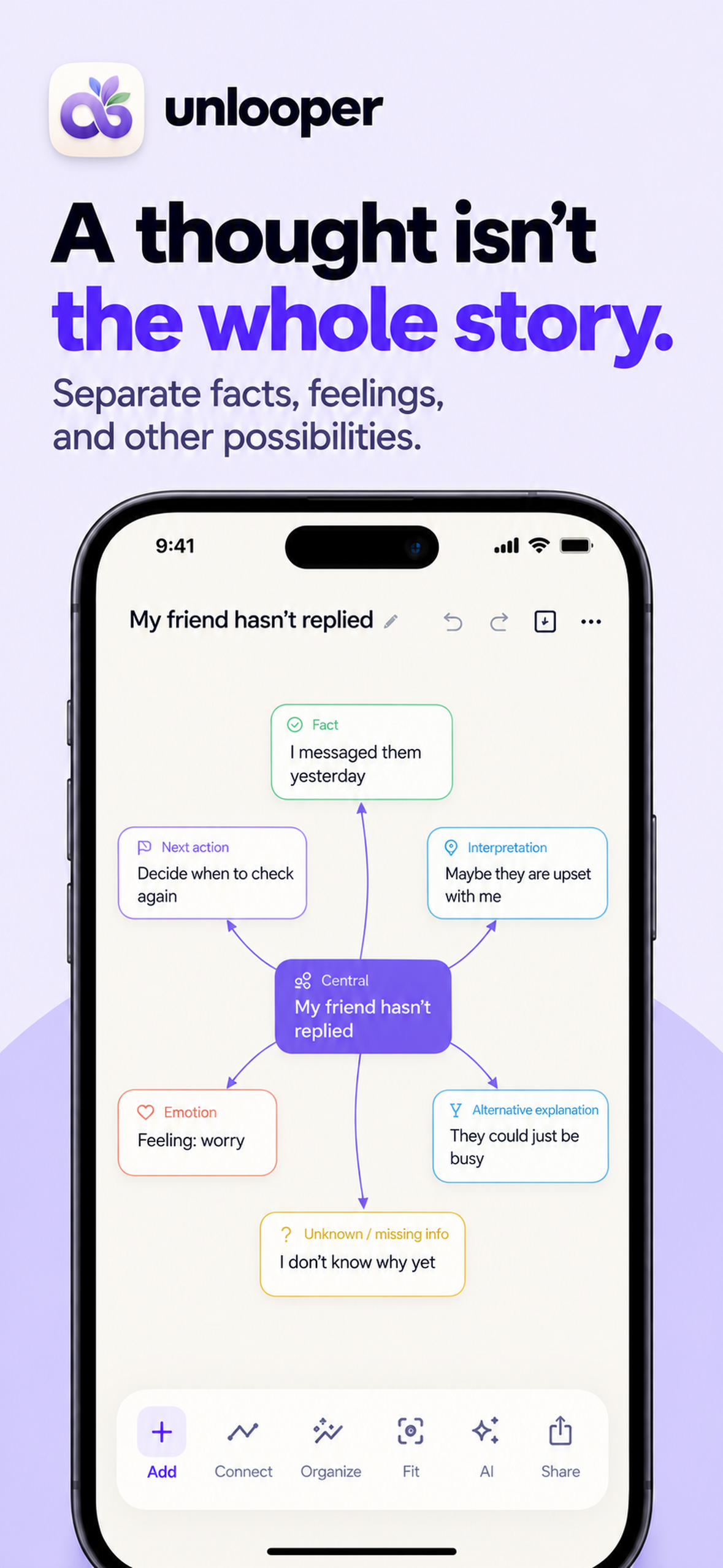
If a ruminative thought has many tangled parts, AI thought maps can turn it into an editable map, with the AI assistant helping you organize it while you decide what stays. Mood check-ins help you notice when rumination tends to show up. Reflections stay on your device by default, with no ads. unLooper is a self-reflection tool, not a medical or diagnostic service.
When to get help
Because research links persistent rumination with depression and anxiety symptoms, it's worth taking seriously. If rumination is frequent, lasts for weeks, disrupts your sleep or daily life, or includes thoughts of self-harm, please talk to a doctor or licensed mental health professional. In the US, you can call or text 988 to reach the 988 Suicide & Crisis Lifeline.
The bottom line
Rumination feels like problem solving but usually keeps you stuck. The research points to a practical way out: notice it, switch from "why" to concrete "what" and "how" questions, step back from yourself, limit the time you give it, and end on an action. You won't stop every loop, but you can shorten them and come out with something useful.
Frequently asked questions
What is rumination?
Rumination is repeatedly and passively focusing on your distress, its causes and its consequences, often by replaying past events or asking why things happened. Unlike problem solving, it tends to circle rather than move toward action.
Is rumination a symptom of depression or anxiety?
Rumination is not a diagnosis on its own, but research has linked it with both. A 2000 study found that rumination predicted the onset and duration of depressive and mixed anxiety and depressive symptoms. If rumination is persistent, it is worth discussing with a professional.
What's the difference between rumination and reflection?
Reflection is usually concrete and curious, focused on understanding what happened and what to do next. Rumination is more abstract and self-critical, focused on why something happened and what it says about you. Reflection tends to end in a decision; rumination tends to repeat.
How long does it take to stop ruminating?
There is no fixed timeline. Many people notice some change within a few weeks of practising techniques consistently, but rumination is a habit, so expect setbacks. If it doesn't ease or affects daily life, professional support can help.

Fahd Chouki is an independent developer and the founder of unLooper. He writes practical guides on overthinking, sleep and decision-making, summarizing published research into steps you can use the same day.
How we write: every guide is based on peer-reviewed research listed in the sources, reviewed for accuracy and updated when evidence changes.
Sources & further reading
- Nolen-Hoeksema, S. (2000). The role of rumination in depressive disorders and mixed anxiety/depressive symptoms. Journal of Abnormal Psychology, 109(3), 504–511. doi:10.1037/0021-843X.109.3.504
- Nolen-Hoeksema, S., Wisco, B. E., & Lyubomirsky, S. (2008). Rethinking rumination. Perspectives on Psychological Science, 3(5), 400–424. doi:10.1111/j.1745-6924.2008.00088.x
- Watkins, E. R. (2008). Constructive and unconstructive repetitive thought. Psychological Bulletin, 134(2), 163–206. doi:10.1037/0033-2909.134.2.163
- Kross, E., & Ayduk, O. (2011). Making meaning out of negative experiences by self-distancing. Current Directions in Psychological Science, 20(3), 187–191. doi:10.1177/0963721411408883
This article is for general information and self-reflection. It is not medical advice and does not replace a doctor or licensed mental-health professional.