How to Make a Decision When You Can't Decide: A 7-Step Method
When you can't decide, stop comparing options in your head. Write down what matters to you, give each criterion a weight, score every option, and imagine each choice failing to spot hidden risks. Then set a deadline, aim for good enough rather than perfect, and commit with one concrete first step.
You've made the pros-and-cons list. You've asked three friends. You've read every review. And you're still stuck, flipping between options and feeling more tired each time.
Indecision rarely comes from a lack of information. It usually comes from unclear priorities, fear of getting it wrong, or hoping one option will suddenly feel obviously perfect. This guide gives you a seven-step method to get unstuck and actually decide.
Why you can't decide (it's not because you're weak)
A few common causes of indecision:
- No clear criteria. You're comparing options without knowing what you're comparing them on.
- Too many options. Every extra option adds trade-offs to juggle.
- Searching for the best, not the good. You want certainty that you've picked the optimal choice.
- Fear of regret. Choosing feels like closing doors forever.
That third point has research behind it. In a 2002 study, Barry Schwartz and colleagues compared "maximizers", people who try to find the best possible option, with "satisficers", people who choose something good enough that meets their standards. Maximizers tended to report less satisfaction and more regret, even though they put more effort into choosing. Chasing the perfect choice can leave you feeling worse about whatever you pick.
How to make a decision when you can't decide: 7 steps
Step 1: Write the decision as one clear question
Fuzzy decisions are impossible to make. Narrow it down to a single question with defined options.
- Fuzzy: "What should I do with my career?"
- Clear: "Should I accept the offer from Company B, or stay in my current role for another year?"
If you have more than four options, cut the ones you know you won't choose.
Step 2: List what matters to you
Write 4 to 6 criteria that genuinely matter for this decision. Be honest; these are your priorities, not what you think you should value. Examples: salary, growth, commute, stability, time with family, how excited you feel.
Step 3: Give each criterion a weight
Not all criteria matter equally. Give each one a weight from 1 (minor) to 5 (essential). This step alone often breaks the deadlock, because it forces you to admit what matters most.
Step 4: Score each option
Rate each option on each criterion from 1 to 10. Multiply by the weight and add it up.
Worked example: stay in current job vs. accept new offer
| Criterion | Weight | Stay (score) | Stay (weighted) | New offer (score) | New offer (weighted) |
|---|---|---|---|---|---|
| Salary | 3 | 6 | 18 | 8 | 24 |
| Growth and learning | 5 | 4 | 20 | 8 | 40 |
| Commute | 2 | 8 | 16 | 5 | 10 |
| Stability | 4 | 8 | 32 | 6 | 24 |
| Team and culture | 4 | 7 | 28 | 7 | 28 |
| Total | 114 | 126 |
The new offer comes out ahead, mainly because growth carries a heavy weight. Now notice your reaction. Relief? Disappointment? If your gut protests, ask what criterion is missing. Maybe "time with my partner" matters and wasn't on the list. Add it and rescore. The point is not to let a spreadsheet decide for you, but to make your trade-offs visible.
For a deeper walkthrough of this tool, see how to make a decision matrix.
Step 5: Run a quick premortem
Imagine it's a year from now and you chose the leading option, and it went badly. Write down every reason why it failed.
This is the "premortem", a technique described by Gary Klein in a 2007 Harvard Business Review article. Imagining a failure that has already happened makes it easier to spot risks people tend to overlook when they're optimistic.
From the example: "The new team was disorganized." "The growth promised in the interview didn't happen." "The longer commute wore me down." Now ask: can I reduce any of these risks? Could you ask to speak with a future teammate, or ask about remote days? Often, the premortem doesn't change the decision, it improves it.
Step 6: Set a deadline and a "good enough" standard
Decide when you'll decide. Write it down: "I'll make the call by Friday at 6pm." Then set a satisficing standard: "If an option scores well on my top two criteria and has no deal-breakers, it's good enough." Given Schwartz's findings, aiming for good enough may leave you more satisfied than searching for the perfect answer.
Step 7: Commit with one concrete first step
A decision isn't finished until you've acted on it. Turn it into an implementation intention, the "if X, then I will Y" format that Peter Gollwitzer's 1999 review linked to better follow-through.
- "If it's Friday at 6pm, then I'll email the recruiter to accept the offer."
- "Once I've accepted, then I'll tell my manager on Monday morning."
Action ends the loop. Without it, your mind is likely to keep reopening the question.
Common traps that keep you stuck
Even with a good method, a few habits can pull you back into indecision. Watch for these:
- Endless research. After a certain point, more reviews and opinions add noise, not clarity. Set a limit, such as "two more sources, then I score."
- Polling everyone you know. Advice is useful, but ten opinions usually means ten different priorities. Ask one or two people whose judgment you trust and who know what matters to you.
- Waiting to feel certain. Most real decisions never feel 100% clear. If you're waiting for certainty, you're waiting for something that may not arrive.
- Treating every decision as permanent. Ask honestly: how hard would this be to reverse or adjust in six months? Many choices are more flexible than they feel.
- Adding options late. Bringing a new option in at the last minute resets the whole process. Unless it's clearly better, park it.
If you notice one of these, name it, return to your criteria and scores, and check your deadline.
Quick decision shortcuts for smaller choices
Not every decision needs a full matrix. For low-stakes or reversible choices, try:
- The 10/10/10 test: How will I feel about this in 10 minutes, 10 months and 10 years?
- The coin flip: Assign each option to a side and flip. You don't have to follow the result; notice whether you feel relief or disappointment when it lands.
- The friend test: What would I tell a friend to do?
- The reversibility check: If I can undo it cheaply, pick the one that looks better right now and move on.
If you're choosing between exactly two options, our guide on how to decide between two options has more methods tailored to that situation.
Copy-and-use decision template
``` DECISION (one clear question): OPTIONS: A) __ B) __ C) __
CRITERIA (weight 1–5): 1. __ ( ) 2. __ ( ) 3. __ ( ) 4. __ ( )
SCORES (1–10) x weight -> total per option
GUT CHECK: How do I feel about the winner? What's missing?
PREMORTEM: It failed a year from now because... Risk reducers:
DEADLINE: I'll decide by __ GOOD ENOUGH means:
FIRST STEP: If __, then I will __. ```
When indecision is a sign of something else
If you find yourself unable to make even small choices at the end of the day, you might be dealing with decision fatigue rather than true indecision. And once you've chosen, if you keep second-guessing yourself, read how to know if you made the right decision.
How unLooper can help
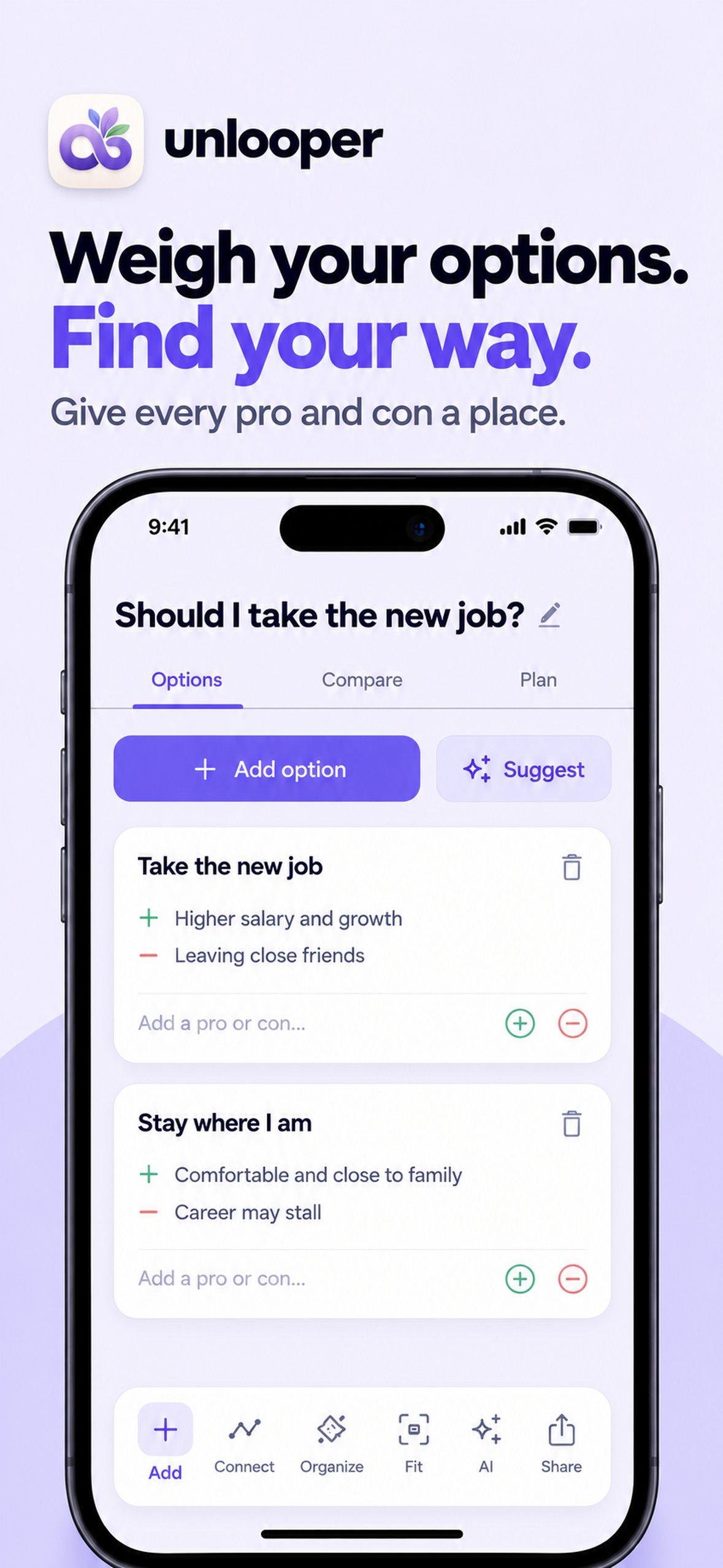
unLooper's Decide for me feature follows the same structure as this method. You list your options and what matters to you, give each criterion a weight, and see how the options compare. You then get an honest AI review of the trade-offs, something like a second opinion that points out what you might be missing, and you make the final call yourself.
If the decision is tangled up with worries, AI thought maps can help you lay out the pieces first. Everything is private by default and stays on your device, with no ads.
The bottom line
You don't need more information to decide; you need a clearer process. Define the question, list and weight what matters, score your options, run a premortem, set a deadline with a good-enough standard, and commit to a first step. A reasonable decision made on time usually beats a perfect one that never arrives.
Frequently asked questions
Why can't I make decisions?
Indecision often comes from fear of choosing wrong, unclear priorities, too many options, or looking for a perfect answer that doesn't exist. Writing down what you value and setting a deadline usually helps more than gathering more information.
Is it better to go with your gut or your head?
Often the best approach uses both. A structured comparison shows you the trade-offs clearly, and your gut reaction to the result tells you whether you've missed something that matters to you. If the scores and your feelings disagree, ask what criterion you forgot.
How long should I take to make a decision?
Match the time to the stakes and reversibility. Small, reversible choices deserve minutes; big, hard-to-reverse choices deserve a set deadline, often a few days to a couple of weeks, with a clear process rather than open-ended thinking.
What if I make the wrong decision?
Most decisions can be adjusted, and few are truly all-or-nothing. Deciding with a clear process means that even if things don't go to plan, you'll know you chose reasonably with what you knew at the time, which makes regret easier to handle.

Fahd Chouki is an independent developer and the founder of unLooper. He writes practical guides on overthinking, sleep and decision-making, summarizing published research into steps you can use the same day.
How we write: every guide is based on peer-reviewed research listed in the sources, reviewed for accuracy and updated when evidence changes.
Sources & further reading
- Schwartz, B., Ward, A., Monterosso, J., Lyubomirsky, S., White, K., & Lehman, D. R. (2002). Maximizing versus satisficing: Happiness is a matter of choice. Journal of Personality and Social Psychology, 83(5), 1178–1197. doi:10.1037/0022-3514.83.5.1178
- Klein, G. (2007). Performing a project premortem. Harvard Business Review, 85(9), 18–19.
- Gollwitzer, P. M. (1999). Implementation intentions: Strong effects of simple plans. American Psychologist, 54(7), 493–503. doi:10.1037/0003-066X.54.7.493
This article is for general information and self-reflection. It is not medical advice and does not replace a doctor or licensed mental-health professional.