Why Anxious Thoughts Get Worse at Night, and What You Can Do
Anxious thoughts often get worse at night because distractions disappear, fatigue weakens your ability to put worries in perspective, and the pressure to fall asleep adds its own arousal. Moving worry earlier in the evening, writing down tomorrow's tasks, and slow breathing before bed may help calm the nighttime spiral.
During the day you manage fine. Then the lights go off, and the same worries that seemed manageable at lunch suddenly feel urgent, enormous, and unsolvable. If your anxious thoughts get worse at night, you are far from alone.
Understanding why it happens takes away some of its power. And once you see the mechanism, the fixes make more sense.
Why do anxious thoughts get worse at night?
There is no single cause. Several things stack up in the evening and make worry louder.
1. The distractions disappear
Daytime is full of input: work, conversations, errands, screens. Those demands keep your attention outside your head. At night, the input stops. Worries that were waiting in the background step forward because nothing else is competing for the spotlight.
2. You are tired, and tired brains catastrophize
By bedtime, your mental energy is low. That makes it harder to put a worry in perspective, think of alternatives, or remember that you have handled similar problems before. A worry that you would shrug off at 10 am can feel overwhelming at 11 pm.
3. You cannot act on anything
At night, the bank is closed, your boss is asleep, and the doctor's office will not answer. Worry thrives on problems you cannot do anything about right now, and nighttime makes almost every problem feel that way.
4. The pressure to sleep adds its own arousal
Harvey (2002) proposed a cognitive model of insomnia in which pre-sleep worry and arousal help maintain sleep problems. Part of that arousal comes from worrying about sleep itself: "If I do not fall asleep now, tomorrow will be a disaster." The more you try to force sleep, the more alert you can become.
5. Unfinished business from the day
Tasks you did not complete, emails you did not send, and conversations that did not resolve tend to resurface when you finally stop moving. Your mind is trying to make sure you do not forget them.
What not to do
Before the fixes, a few common habits tend to make nighttime anxiety worse:
- Scrolling in bed to distract yourself, which can keep you alert and feed new worries.
- Problem-solving in the dark. Night is the worst time to make plans, because you are tired and cannot act.
- Checking the clock and calculating how much sleep you have left.
- Trying to force the thoughts away, which often makes them bounce back.
What you can do: an evening plan for anxious nights
Step 1: Move your worry earlier
Set aside 15 minutes in the early evening, well before bed, to deal with worries on purpose. Write each one down, and for each, note one next step for tomorrow. This gives your mind a clear message that worries have been heard and have a plan.
Step 2: Write tomorrow's to-do list before bed
Scullin and colleagues (2018) ran a sleep-lab study in which participants spent five minutes before bed writing either a specific to-do list or a list of tasks they had completed. Those who wrote a specific to-do list fell asleep faster, and the more specific their lists, the faster they fell asleep.
Keep it concrete: "Email Dana about the invoice at 9 am" works better than "deal with work stuff." For a full template, see our brain dump before bed guide.
Step 3: Separate tonight's worries from tomorrow's
Most nighttime worries belong to tomorrow or later. Ask of each one: "Can I do anything about this tonight?" If not, it goes on the list for tomorrow. If something truly needs attention tonight, deal with it quickly and then stop.
Step 4: Slow your breathing
Zaccaro and colleagues (2018) published a systematic review that linked slow breathing techniques with increased relaxation, greater parasympathetic activity, and reduced arousal. You do not need anything complicated.
Try this for three minutes:
- Breathe in gently through your nose for about four counts.
- Breathe out slowly through your mouth for about six counts.
- Keep the rhythm easy, not forced.
- If your mind wanders to a worry, notice it and return to counting.
Step 5: Ground yourself in the room
When thoughts are pulling you into the future, bring your attention to the present with your senses. Notice the weight of the blanket, the temperature of the air, three sounds you can hear. It is simple, and it gives your mind something neutral to hold.
Step 6: Protect your sleep window
A consensus statement from the American Academy of Sleep Medicine and Sleep Research Society (Watson et al., 2015) recommends that adults regularly get seven or more hours of sleep per night. Going to bed at a consistent time with enough room for seven hours means you are not lying there doing anxious math about how little sleep you will get.
Worked example: Sunday night dread
Situation: It is Sunday at 10:30 pm. You are in bed thinking about a Monday meeting, an overdue bill, and a strange comment your sister made.
What usually happens: You replay the comment, rehearse the meeting, and remember the bill at 1 am in a panic.
The new plan:
- 7:00 pm worry slot: You write the three worries down. Meeting: review slides Monday 8:30 am. Bill: pay online first thing Monday. Sister: text her Tuesday to ask what she meant.
- 9:45 pm to-do list: "8:30 review slides, 8:45 pay electric bill, Tuesday text Sam."
- 10:30 pm in bed: When the meeting comes to mind, you tell yourself, "It is on the list for 8:30." Three minutes of slow breathing with a longer out-breath. Notice the pillow, the sound of the fan.
The worries are still real. They just have a time and place that is not your pillow.
Copy-ready checklist: the anxious night routine
- ☐ Early evening: 15-minute worry slot, each worry gets a next step.
- ☐ One hour before bed: screens down or dimmed.
- ☐ Before bed: five-minute specific to-do list for tomorrow.
- ☐ Sort: tonight's worries vs tomorrow's.
- ☐ In bed: three minutes of slow breathing (in 4, out 6).
- ☐ If thoughts return: "It is on the list," then ground in the room.
- ☐ Bedtime set to allow seven or more hours of sleep.
If you are already in bed and wide awake, our article on racing thoughts at night focuses on exactly that moment. For a full bedtime routine, see how to stop overthinking at night. And if your nighttime worries are mostly about what is coming, how to stop worrying about the future can help during the day.
How unLooper can help
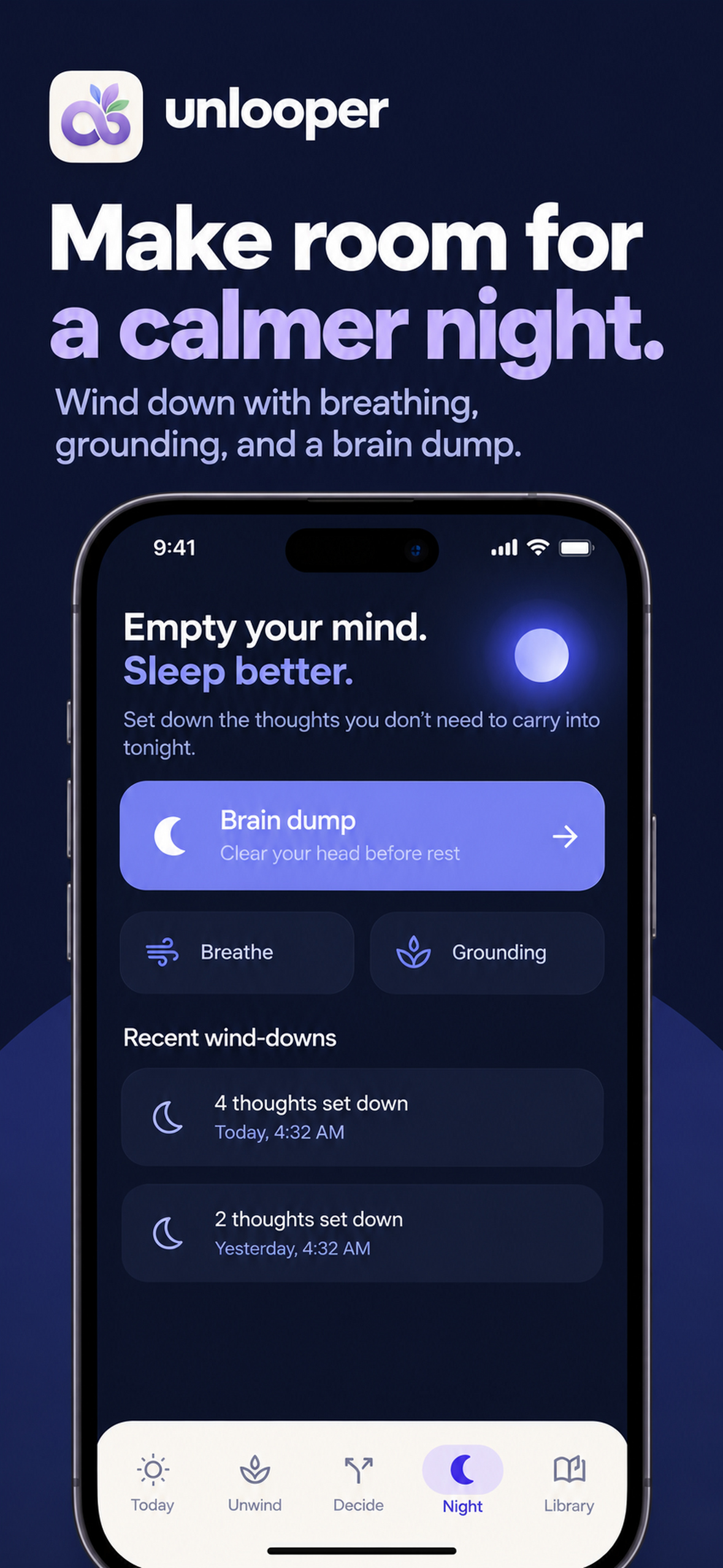
unLooper's Quiet Mind at Night is built around the steps above. It starts with a bedtime brain-dump that sorts tomorrow's worries from tonight's, so you can set down what does not need you right now. Then it guides you through breathing and grounding to wind down.
You can set a bedtime reminder so the routine happens before you are already lying awake, and use mood check-ins to see whether your nights are getting calmer over time. unLooper is a self-reflection tool, not a medical service. Reflections stay private on your device, with no ads.
When to get help
If nighttime anxiety is persistent, regularly disrupts your sleep or daily life, or comes with thoughts of self-harm, please talk to a doctor or licensed mental-health professional. In the US, you can call or text 988 to reach the Suicide & Crisis Lifeline.
The bottom line
Anxious thoughts get worse at night because distractions fade, fatigue magnifies problems, and the pressure to sleep adds arousal. Move worry earlier, write tomorrow down, sort what belongs to tonight, and slow your breath. The night does not have to be where your worries live.
Frequently asked questions
Why does anxiety get worse when I lie down?
Lying down removes the activity and noise that kept your attention busy during the day, so worries have more room. The quiet and darkness also make it easier to focus inward, and trying hard to fall asleep can raise arousal further.
Is nighttime anxiety normal?
It is very common for worries to feel bigger at night. If it happens occasionally, practical routines are usually enough. If it is frequent, long-lasting, or affects your daytime functioning, talk to a doctor or mental-health professional.
Why do problems seem worse at 3 am?
At 3 am you are tired, alone, and unable to act on anything, which makes problems feel bigger and less solvable. The same worry usually looks more manageable in the morning when you have energy and options.
What should I do if anxiety wakes me up at night?
Avoid checking the time or your phone. Try slow breathing with a longer exhale, write the worry on a notepad by the bed, and remind yourself that you will deal with it tomorrow. If you are awake for a long time, getting up briefly to do something calm in dim light may help.

Fahd Chouki is an independent developer and the founder of unLooper. He writes practical guides on overthinking, sleep and decision-making, summarizing published research into steps you can use the same day.
How we write: every guide is based on peer-reviewed research listed in the sources, reviewed for accuracy and updated when evidence changes.
Sources & further reading
- Harvey, A. G. (2002). A cognitive model of insomnia. Behaviour Research and Therapy, 40(8), 869–893. doi:10.1016/S0005-7967(01)00061-4
- Scullin, M. K., Krueger, M. L., Ballard, H. K., Pruett, N., & Bliwise, D. L. (2018). The effects of bedtime writing on difficulty falling asleep: A polysomnographic study comparing to-do lists and completed activity lists. Journal of Experimental Psychology: General, 147(1), 139–146. doi:10.1037/xge0000374
- Zaccaro, A., et al. (2018). How breath-control can change your life: A systematic review on psycho-physiological correlates of slow breathing. Frontiers in Human Neuroscience, 12, 353. doi:10.3389/fnhum.2018.00353
- Watson, N. F., et al. (2015). Recommended amount of sleep for a healthy adult: A joint consensus statement of the AASM and SRS. Sleep, 38(6), 843–844. doi:10.5665/sleep.4716
This article is for general information and self-reflection. It is not medical advice and does not replace a doctor or licensed mental-health professional.