How to Organize Your Thoughts When Your Mind Feels Cluttered
To organize your thoughts, dump everything onto paper first, then group related items into clusters, connect the clusters around one central question, and mark what is fact, fear, or action. Finally, pick the one branch that matters most and write a next step. This process is called thought mapping.
Your head feels like a browser with forty tabs open. Work tasks, a conversation you need to have, money, a decision you are avoiding, something someone said, and a vague sense that you are forgetting something important. Everything feels equally urgent, so nothing gets done.
Organizing your thoughts is less about thinking harder and more about getting them out of your head and into a structure you can see. This guide shows you how with a method called thought mapping.
Why your thoughts feel so scattered
Your working memory can only hold a handful of things at once. When you try to juggle more, thoughts start colliding. You jump from one worry to the next without finishing any of them, and the jumping itself feels exhausting.
Scattered thinking also tends to stay abstract. You think "everything is a mess" rather than "I have three overdue tasks and one hard conversation." Watkins (2008) reviewed research on repetitive thought and found that concrete, specific thinking is generally more constructive than abstract, evaluative thinking. Organizing your thoughts is largely a process of making them concrete.
And there is a cost to leaving the clutter alone. Nolen-Hoeksema, Wisco and Lyubomirsky (2008) concluded that rumination tends to impair problem solving and prolong distress. A messy, looping mind is not a great place to solve problems from.
What is thought mapping?
A thought map is a visual layout of what is on your mind. It has:
- A center: the main question or theme ("What is stressing me this week?").
- Branches: the main clusters of thoughts (work, money, relationships).
- Leaves: specific items under each branch.
- Labels: marks that tell you what each item is, such as fact, fear, or action.
Unlike a list, a map shows relationships. You can see that your money worry and your work worry are actually the same issue, or that one small action would resolve three leaves at once.
How to organize your thoughts in 6 steps
Step 1: Dump everything out
Set a timer for 10 minutes and write every thought on your mind, one per line or one per sticky note. Tasks, worries, ideas, feelings, half-formed questions. Do not organize yet. Do not judge.
Pennebaker (1997) reviewed research on expressive writing and found that writing about emotional experiences has been linked to benefits for many people. Even without the emotional depth of a full journal entry, getting thoughts onto paper frees up mental space.
Step 2: Choose a central question
Look at your dump and ask, "What is the real question underneath all of this?" It might be "How do I get through this week?" or "Should I stay in this job?" or simply "What is on my mind?"
Write it in the center of a page.
Step 3: Cluster into branches
Group related items. You will usually find three to six natural clusters. Common ones:
- Work or school
- Money
- Relationships
- Health and energy
- Home and admin
- A specific decision
Draw a branch from the center for each cluster and write the items as leaves.
Step 4: Label each leaf
Go through every leaf and mark it:
- F for fact ("Rent is due on the 1st")
- W for worry or fear ("I might not have enough")
- A for action ("Transfer $200 from savings")
- ? for open question ("Can I ask for an extension?")
This step separates what is true from what you are afraid of, and it shows how many items are actually actionable.
Step 5: Draw connections
Look for leaves that affect each other and draw lines between them. Maybe the late project at work is why you are not sleeping, and not sleeping is why you snapped at your partner. Connections often reveal one root issue behind several symptoms.
Step 6: Pick one branch and one next step
Choose the branch that would make the biggest difference if you made progress on it. Then write one concrete action for the next 24 hours. You do not need to solve the whole map today. You need to start on the part that matters most.
Worked example: a cluttered Sunday evening
Brain dump: Project deadline Friday. Did not reply to Mia. Car making a noise. Credit card bill. Should I take the course? Tired all week. Mom's birthday. Gym membership. Team meeting I am nervous about. Need groceries.
Central question: "What do I need to handle this week?"
Branches and labels:
- Work: Project deadline Friday (F). Nervous about team meeting (W). Should I take the course? (?)
- Money: Credit card bill (F, A: pay Tuesday). Gym membership (? cancel or keep).
- People: Reply to Mia (A). Mom's birthday Thursday (F, A: order gift).
- Life admin: Car noise (A: book mechanic). Groceries (A).
- Energy: Tired all week (F).
Connections: Tiredness connects to the project deadline (late nights) and the meeting nerves. The project is the root issue.
One branch, one step: Work. Next step: "Block two hours Monday morning for the project, phone off."
Ten thoughts that felt like chaos became five branches, one root cause, and a clear first move.
Copy-ready template: the one-page thought map
Use this on paper or in any notes app:
- Central question:
- Branch 1 (name): items, each labeled F / W / A / ?
- Branch 2 (name): items, each labeled F / W / A / ?
- Branch 3 (name): items, each labeled F / W / A / ?
- Branch 4 (name, optional):
- Connections I notice:
- The branch that matters most this week:
- One action in the next 24 hours:
Redo the map weekly, or whenever your mind starts to feel like forty open tabs again.
Tips for keeping your thoughts organized
- Capture continuously. Keep one place, a note or notebook, where every new thought goes as it appears.
- Review at a set time. A short daily or weekly review keeps the map current and stops thoughts from piling up.
- Move decisions out. If a branch is really a choice, take it to a structured tool. Our guide on how to make a decision matrix shows how.
- Use it before bed. A quick sort before sleep can help separate tonight from tomorrow. See brain dump before bed.
If one branch keeps spiraling no matter how you organize it, it may be a thought loop. Our article on how to break a negative thought loop goes deeper on that, and how to calm your mind from overthinking fast covers quick resets for the moment.
How unLooper can help
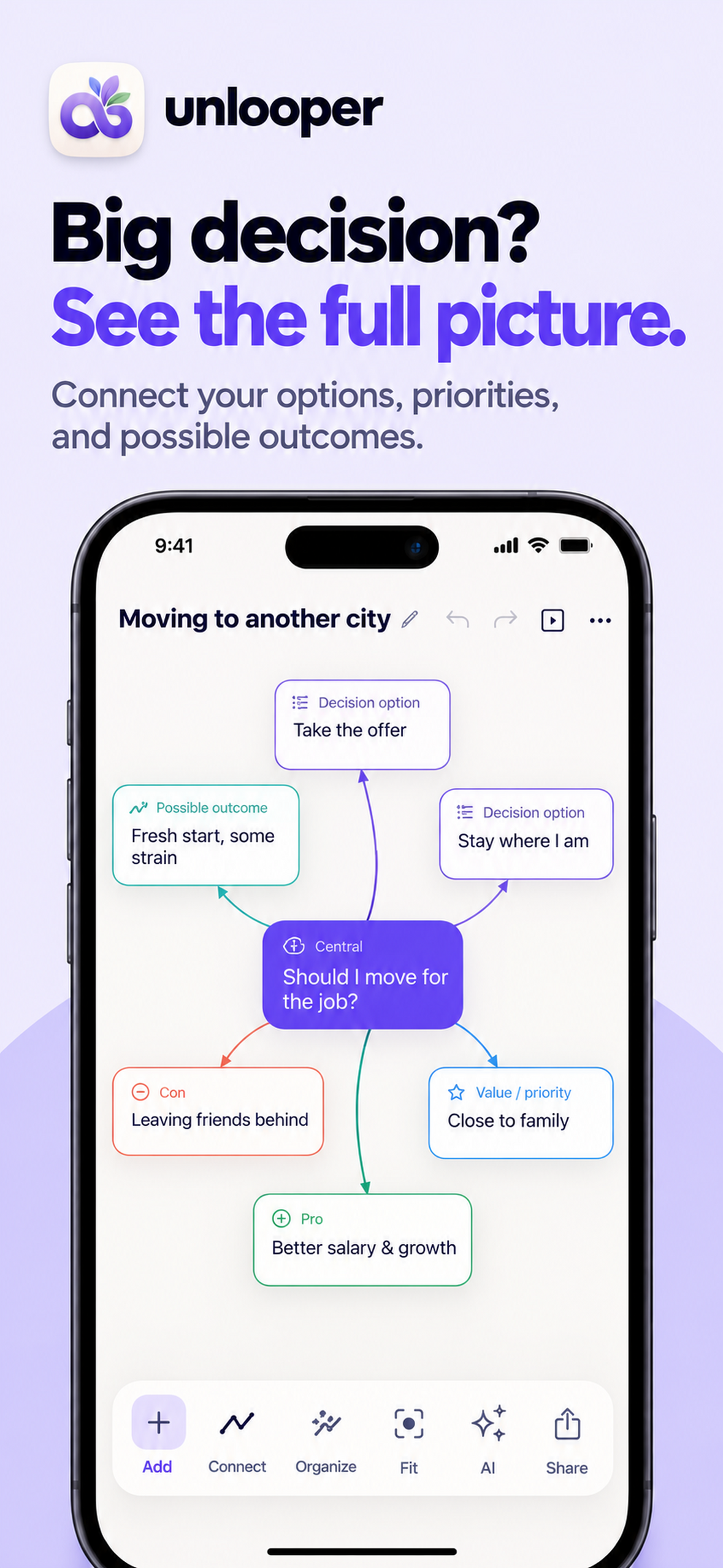
unLooper's AI thought maps are built for exactly this method. You can turn a tangled thought into an editable map, with branches and nodes you can rearrange as your understanding changes. The AI assistant can help develop or organize a map you started, or draft a new one from what you describe, and you stay in control of every change.
When a branch turns out to be a decision, Decide for me lets you weigh the options against what matters to you. And if a single thought keeps looping, the Overthinking Breaker guides you through a short session that ends on one small step. Reflections stay on your device, with no ads.
When to get help
If your thoughts feel persistently overwhelming, disrupt your daily life, or come with thoughts of self-harm, please talk to a doctor or licensed mental-health professional. In the US, you can call or text 988 to reach the Suicide & Crisis Lifeline.
The bottom line
To organize your thoughts, get them out, find the central question, cluster them into branches, label facts, fears, and actions, draw the connections, and choose one next step. A thought map turns a cluttered mind into something you can see, and what you can see, you can work with.
Frequently asked questions
What is thought mapping?
Thought mapping is a visual way to organize what is in your head. You place a central question or topic in the middle, then branch out into related ideas, worries, facts, and actions. Seeing the connections makes it easier to understand what is really going on and what to do next.
How do I organize my thoughts when I feel overwhelmed?
Start by getting everything out of your head without sorting, then group similar items. Overwhelm usually comes from holding too many separate thoughts at once. Once they are on paper and clustered, most people find there are only a few real issues.
Is a thought map the same as a mind map?
They are similar. A mind map is often used for brainstorming or studying, while a thought map focuses on personal thoughts, worries, and decisions. The structure is the same: a center, branches, and connections.
How can I organize my thoughts before speaking or writing?
Write your main point in one sentence, then list two or three supporting points under it, and finish with what you want the listener to do or understand. That simple structure keeps you on track and reduces rambling.

Fahd Chouki is an independent developer and the founder of unLooper. He writes practical guides on overthinking, sleep and decision-making, summarizing published research into steps you can use the same day.
How we write: every guide is based on peer-reviewed research listed in the sources, reviewed for accuracy and updated when evidence changes.
Sources & further reading
- Watkins, E. R. (2008). Constructive and unconstructive repetitive thought. Psychological Bulletin, 134(2), 163–206. doi:10.1037/0033-2909.134.2.163
- Pennebaker, J. W. (1997). Writing about emotional experiences as a therapeutic process. Psychological Science, 8(3), 162–166. doi:10.1111/j.1467-9280.1997.tb00403.x
- Nolen-Hoeksema, S., Wisco, B. E., & Lyubomirsky, S. (2008). Rethinking rumination. Perspectives on Psychological Science, 3(5), 400–424. doi:10.1111/j.1745-6924.2008.00088.x
This article is for general information and self-reflection. It is not medical advice and does not replace a doctor or licensed mental-health professional.