How to Stop Overthinking the Past and Make Peace With It
To stop overthinking the past, swap abstract why questions for concrete what and how questions, look at the memory from a distance as an observer, write it out once to close the loop, and turn any real lesson into one present-day action. The memory stays, but its grip loosens.
A conversation from five years ago. A decision you made at 22. Something you said at a party that still makes you wince. The past has a way of showing up uninvited, often when you are trying to sleep or focus.
If you keep replaying old moments, you are not broken. But you can learn to set them down. This guide shows you how.
What overthinking the past actually looks like
Overthinking the past is not the same as remembering. Remembering is a scene that comes and goes. Overthinking is the scene on repeat, with commentary: "Why did I do that? What is wrong with me? If only I had..."
Common forms include:
- Replaying mistakes: rerunning a choice and its consequences.
- Cringe flashbacks: sudden embarrassing memories with a jolt of shame.
- What-if loops: imagining the life you would have if one thing went differently.
- Old hurts: going back over what someone did to you.
Why dwelling on the past is costly
It feels like reflection, but repetitive dwelling often makes things worse. In a 2000 study, Nolen-Hoeksema found that a ruminative style predicted the onset and duration of depressive and mixed anxiety and depressive symptoms. Repetitive focus on what went wrong, especially about yourself, tends to keep low feelings around longer.
That does not mean thinking about the past is always bad. Watkins (2008) reviewed research on repetitive thought and found that its effects depend on how you do it. Concrete, process-focused thinking ("what happened, step by step, and what could I do differently?") tends to be helpful. Abstract, evaluative thinking ("why am I like this?") tends to keep people stuck. That distinction is the key to everything below.
If you want a deeper look at the research on rumination itself, read our guide on how to stop ruminating. Here we will stay practical and focus on specific memories.
How to stop overthinking the past: 6 steps
1. Name the memory in one line
Give the memory a short, neutral title, like a file name: "The job interview in 2021" or "What I said to Dad at the wedding." Naming turns a flood of feeling into a specific event with edges.
2. Swap why questions for what and how questions
This is the most important step. Take the abstract question you keep asking and rewrite it as a concrete one.
| Abstract (keeps you stuck) | Concrete (moves you forward) |
|---|---|
| Why did I ruin that? | What exactly happened in the moment? |
| Why am I so awkward? | What was going on for me that day? |
| Why didn't I see it coming? | What signs were there, and what would I notice now? |
| What is wrong with me? | What would I do differently in a similar situation? |
Concrete questions have answers. Abstract ones mostly have more questions.
3. Watch it like a film, from the back row
Kross and Ayduk (2011) found that self-distancing, viewing an experience from an observer's perspective rather than reliving it through your own eyes, can reduce emotional reactivity and rumination. Try replaying the memory as if you were watching it from the back of a theater, seeing yourself as one character.
You might notice the younger you was nervous, tired, or doing their best with what they knew. That compassion is hard to access from inside the scene.
4. Write it out once, fully
Set a timer for 15 minutes and write about the memory: what happened, how it felt, and what it means to you now. Pennebaker (1997) reviewed studies on expressive writing and found that writing about emotional experiences has been linked to benefits for many people.
The goal is not a perfect essay. It is to get the whole story out of your head and onto a page, so your mind does not have to keep holding it.
5. Extract one lesson and one action
Ask: "Is there anything useful here for today?" If yes, write one lesson and one small action you can take now. If you hurt someone, maybe the action is an apology. If you missed an opportunity, maybe it is applying for the next one.
If there is no lesson, that is also an answer. Some memories are just uncomfortable, not instructive.
6. Close the file
Read what you wrote, then say or write a closing line: "This happened. I have learned what I can. I am putting it down." When the memory comes back, you do not need to reopen it. You can say, "That file is closed," and return to what you were doing.
It will come back sometimes. Each time you do not reopen it, the pull gets weaker.
Worked example: the presentation that went wrong
Memory title: The quarterly presentation, March last year.
Old question: "Why did I freeze in front of everyone? I am so incompetent."
Concrete version: "What happened? I lost my place on slide four after the projector glitched, and I had not rehearsed out loud."
Observer view: "A person who had prepared the content well got thrown by a technical glitch and lost their rhythm for about 30 seconds. Then they finished."
Expressive writing (excerpt): "I felt my face burn and I was sure everyone was judging me. Looking back, my manager actually said the data was strong."
Lesson: "I rehearse out loud at least once and bring printed notes."
Action: Book a 20-minute rehearsal slot before the next presentation.
Closing line: "It was 30 seconds of a long career. File closed."
Copy-ready template: the past-closure worksheet
Use this for any memory that will not stay put:
- Memory title (one line):
- The why question I keep asking:
- The concrete what or how version:
- What I see when I watch it from the back row:
- What I would say to a friend who told me this story:
- One lesson (or "no lesson, just uncomfortable"):
- One action I can take now:
- My closing line:
When the past is really about one decision
If the memory you keep revisiting is a specific choice, such as a job you turned down or a move you made, our guide on how to get over a bad decision walks through separating a bad decision from a bad outcome. And if the past tends to flood in after dark, our article on racing thoughts at night covers what to do when you are already in bed.
How unLooper can help
unLooper is a self-reflection app designed for these replay loops. Its Overthinking Breaker is a guided session of about three minutes that helps you separate fact from fear, find other angles on a memory, and end on one small doable step, much like steps 2, 3, and 5 above.
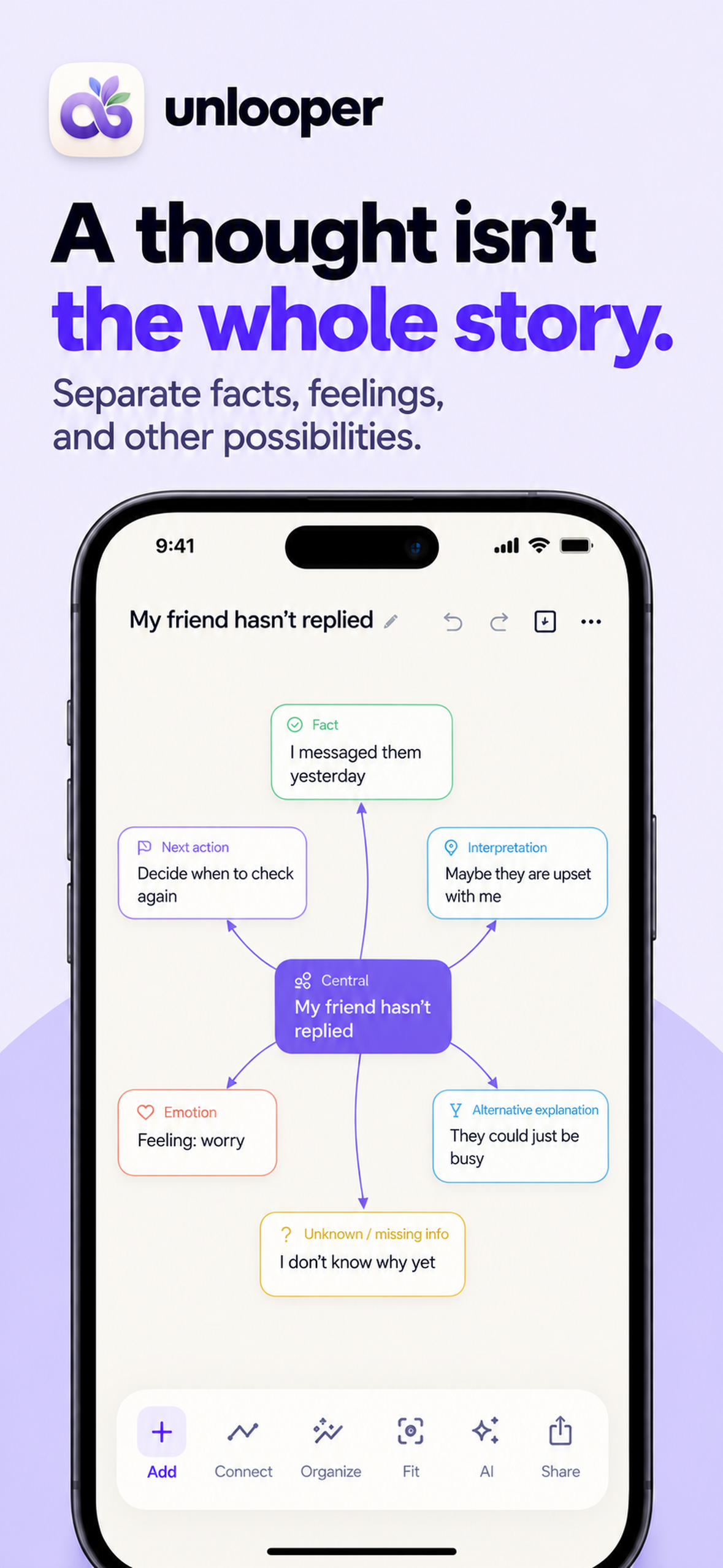
If a memory is tangled up with many others, an AI thought map lets you lay it out in an editable view, with the AI assistant helping organize it while you decide what stays. Mood check-ins let you notice how often the past is pulling at you. Reflections stay private on your device, and there are no ads.
When to get help
If thoughts about the past are persistent, disrupt your daily life, or come with thoughts of harming yourself, please reach out to a doctor or a licensed mental-health professional. In the US, you can call or text 988 to reach the Suicide & Crisis Lifeline.
The bottom line
You cannot rewrite the past, but you can change how you hold it. Ask concrete questions, watch from the back row, write it out once, keep one lesson, and close the file. For a broader approach to overthinking in all its forms, see how to stop overthinking everything.
Frequently asked questions
Why do I keep thinking about the past?
The mind returns to past events that feel unresolved, painful, or embarrassing, hoping to make sense of them. Sometimes that brings insight, but repetitive, abstract replaying tends to keep the feeling alive instead of resolving it.
How do I stop cringing about old memories?
Cringe memories usually fade faster when you stop fighting them. Notice the memory, name it briefly, and remind yourself that others rarely remember your awkward moments as vividly as you do. Then move your attention to something concrete in the present.
Is overthinking the past a sign of depression?
Not on its own. Many people dwell on the past from time to time. Research does link persistent rumination with a higher risk of low mood, so if replaying the past is constant and you feel down most days, it is worth talking to a professional.
Can you change how you feel about the past?
You cannot change what happened, but you can change the story you tell about it and what you do because of it. Reframing a memory from an observer's point of view and drawing one lesson from it often makes it feel lighter.

Fahd Chouki is an independent developer and the founder of unLooper. He writes practical guides on overthinking, sleep and decision-making, summarizing published research into steps you can use the same day.
How we write: every guide is based on peer-reviewed research listed in the sources, reviewed for accuracy and updated when evidence changes.
Sources & further reading
- Nolen-Hoeksema, S. (2000). The role of rumination in depressive disorders and mixed anxiety/depressive symptoms. Journal of Abnormal Psychology, 109(3), 504–511. doi:10.1037/0021-843X.109.3.504
- Watkins, E. R. (2008). Constructive and unconstructive repetitive thought. Psychological Bulletin, 134(2), 163–206. doi:10.1037/0033-2909.134.2.163
- Kross, E., & Ayduk, O. (2011). Making meaning out of negative experiences by self-distancing. Current Directions in Psychological Science, 20(3), 187–191. doi:10.1177/0963721411408883
- Pennebaker, J. W. (1997). Writing about emotional experiences as a therapeutic process. Psychological Science, 8(3), 162–166. doi:10.1111/j.1467-9280.1997.tb00403.x
This article is for general information and self-reflection. It is not medical advice and does not replace a doctor or licensed mental-health professional.