How to Stop Overthinking at Night (and Actually Fall Asleep)
To stop overthinking at night, give your worries an earlier slot in the evening, write tomorrow's tasks down before bed, and lower your arousal with slow breathing. A predictable 30-minute wind-down tells your brain the day is closed, so thoughts have less reason to resurface once the lights go off.
You finally turn off the light, and your mind turns on. The email you forgot to send, the comment a coworker made, the bills next month. You are tired, yet your brain acts like it is the middle of the afternoon.
The good news: night-time overthinking is often less about your thoughts and more about timing. Below is a practical evening routine that moves the thinking earlier, closes the day on paper, and helps your body slow down before you get into bed.
Why does overthinking get worse at night?
During the day, your attention is pulled in a dozen directions. At night, the noise drops away and whatever is unfinished gets the spotlight. Your mind is not malfunctioning; it is trying to solve open problems at the worst possible moment.
Psychologist Allison Harvey's 2002 cognitive model of insomnia describes how this becomes a cycle. Worry before sleep raises mental and physical arousal, that arousal keeps you awake, and lying awake gives you even more time to worry. Breaking the cycle means working on both sides: fewer open loops in your head, and a calmer body.
If you want to go deeper on the "why", see our guide on why anxious thoughts get worse at night. This article focuses on the routine itself.
How to stop overthinking at night: a 9-step bedtime routine
You don't need all nine steps every night. Start with steps 2, 4 and 7, then add the others as they become habits.
1. Set a "worry window" earlier in the evening
Pick a 15-minute slot, ideally a few hours before bed, when you are allowed to think through worries on purpose. When a worry appears later, tell yourself, "That belongs to tomorrow's worry window."
This idea comes from stimulus-control research. In a 1983 study, Borkovec and colleagues asked chronic worriers to postpone worrying to a set daily period and place, and participants reported less worry. It sounds too simple, but giving worry a scheduled home makes it easier to say "not now".
2. Write tomorrow's to-do list before bed
Take five minutes and write down specifically what you need to do in the next few days. Not "work stuff", but "send the revised quote to Dana by 11am".
A 2018 sleep-lab study by Scullin and colleagues found that participants who wrote a specific to-do list for five minutes before bed fell asleep faster than those who wrote about tasks they had already completed. The more specific the list, the faster they tended to fall asleep. Writing it down seems to reassure your brain that nothing will be forgotten.
For a fuller version with prompts and templates, see our brain dump before bed method.
3. Separate tonight's worries from tomorrow's
Look at what is on your mind and sort it into two piles:
- Tomorrow: things you can act on, but not at 11pm (calls, emails, errands, decisions).
- Tonight: feelings you are carrying right now (hurt, anxious, lonely, restless).
Tomorrow's items go on the list from step 2. Tonight's items need something different: acknowledgment and calming, not solving.
4. Turn each worry into one small next step
A worry with no plan keeps circling. A worry with a next step can rest. For each "tomorrow" item, write a single doable action and, if possible, when you will do it.
Worked example:
- Worry: "My manager seemed annoyed in the meeting. Am I in trouble?"
- Fact: She said the report was late. She didn't say anything else.
- Fear: "She thinks I'm bad at my job."
- Next step: "At 9:30 tomorrow, ask her if the new deadline works and whether she wants changes."
Once that line is written, there is nothing left to do tonight. You can remind yourself of that if the thought comes back.
5. Dim the lights and set a screen cut-off
Bright screens and endless scrolling keep your mind engaged and give it fresh material to chew on. Aim to put your phone down (or switch to a calm, offline activity) 30 to 60 minutes before you want to sleep. Lower the lights in your home at the same time to signal the shift.
6. Do something boring and pleasant
Overthinking fills a vacuum. A light, low-stakes activity gives your attention somewhere gentle to rest: a paper book you've read before, stretching, folding laundry, a warm shower. Avoid work, news and heated group chats.
7. Practise slow breathing for 3 to 5 minutes
Try breathing in through your nose for about four seconds and out for about six, around six breaths per minute. A 2018 systematic review by Zaccaro and colleagues linked slow breathing techniques with increased relaxation and parasympathetic ("rest and digest") activity, and reduced arousal. You are working directly on the body side of Harvey's cycle.
8. Ground yourself if your mind starts racing again
If thoughts speed up, bring attention to your senses. Name five things you can see, four you can feel, three you can hear. Then return to your breathing. The goal is not to empty your mind, only to give it something steadier than the worry.
9. Keep a "parking lot" by the bed
Some thoughts will still pop up in bed. Keep a notepad (or a note on your phone with the screen dimmed) nearby and write a few words: "car insurance renewal". Then remind yourself it is parked until the morning. If you are already in bed and wide awake, our guide on what to do when racing thoughts keep you up covers that moment specifically.
A copy-and-use bedtime checklist
Print this or save it to your notes. Tick through it each evening for two weeks.
- ☐ Worry window done (15 min, earlier in the evening)
- ☐ Tomorrow's to-do list written, specific and dated
- ☐ Worries sorted: tomorrow vs. tonight
- ☐ One next step written for each "tomorrow" worry
- ☐ Screens off and lights dimmed 30–60 min before bed
- ☐ 10–20 minutes of something calm and boring
- ☐ 3–5 minutes of slow breathing
- ☐ Notepad by the bed for anything new
What if the routine doesn't work right away?
Give it at least a week. Your brain has probably learned that bedtime is "thinking time", and unlearning that association takes repetition. Expect some nights to go better than others.
A few common adjustments:
- The list makes you more anxious. Keep it shorter and stop at the first three items. Add a closing line like "Everything else can wait until tomorrow."
- You forget the worry window. Attach it to something you already do, such as right after dinner or after brushing your teeth.
- You wake up at 3am thinking. Use the parking lot and breathing steps. Don't check the clock repeatedly; it tends to add pressure.
If you need something quicker for an anxious moment during the day, try these fast ways to calm your mind in under three minutes.
How unLooper can help
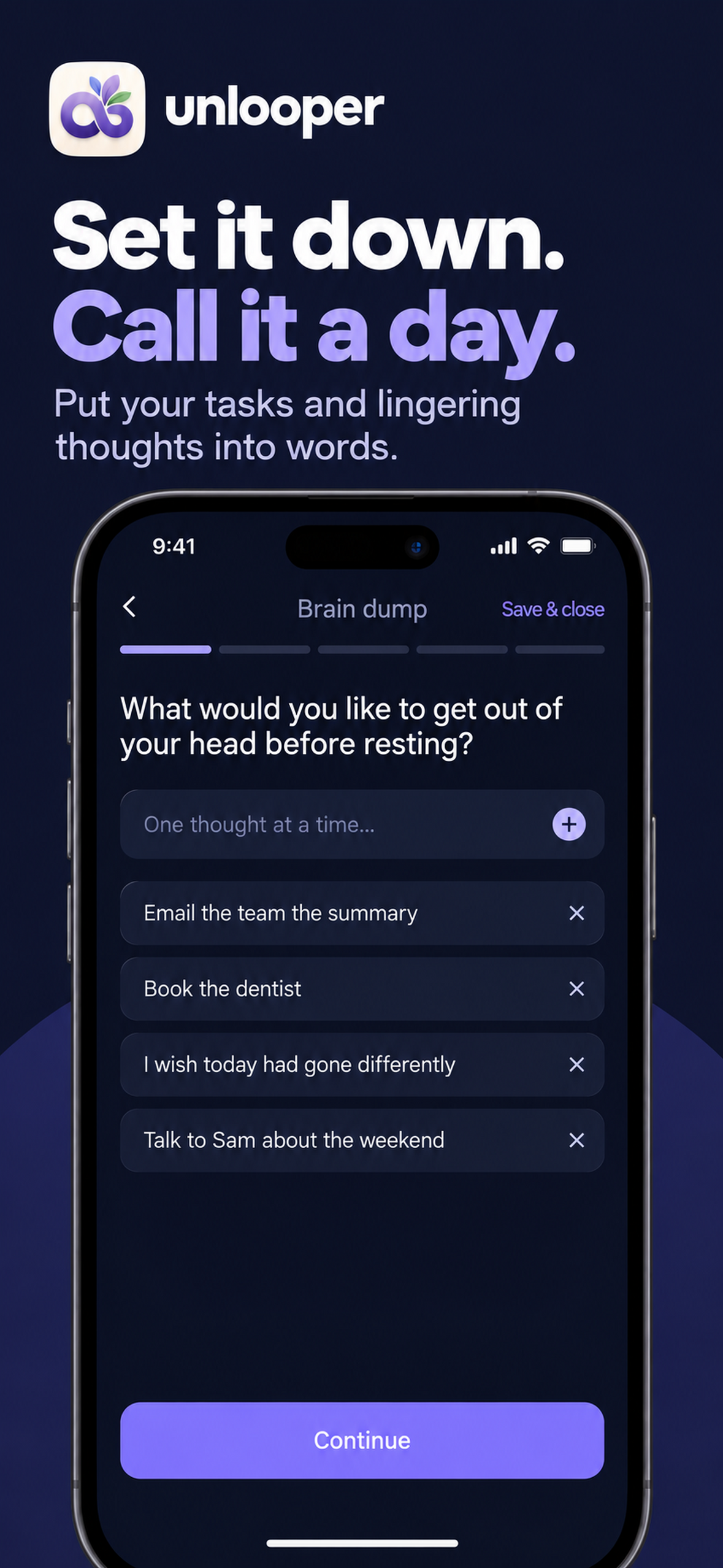
unLooper's Quiet Mind at Night follows the same structure as this routine. You start with a bedtime brain-dump, and the app helps you sort tomorrow's worries from tonight's, so actionable items are written down and set aside. It then moves into guided breathing and grounding to help you wind down.
If one worry feels heavier than the rest, the Overthinking Breaker is a guided session of about three minutes that separates fact from fear and ends on one small doable step, much like the worked example above. You can also set a gentle bedtime reminder. Your reflections stay on your device, and there are no ads. unLooper is a self-reflection tool, not a medical service.
When to get help
If overthinking at night is persistent, regularly costs you sleep, or affects your work and relationships, talk to a doctor or a licensed mental health professional. If your thoughts include harming yourself, reach out right away: in the US, you can call or text 988 to reach the 988 Suicide & Crisis Lifeline.
The bottom line
You can't force your mind to go quiet, but you can change when and how it does its thinking. Give worry an earlier slot, close the day on paper with one next step per concern, and help your body slow down with breathing. Do it consistently, and bedtime can slowly go back to being for sleep.
Frequently asked questions
Why do I overthink more at night than during the day?
During the day, tasks and conversations keep your attention busy. At night those distractions disappear, so unresolved worries move into the empty space. Research on insomnia suggests that this pre-sleep worry raises arousal, which then makes it harder to fall asleep.
Does writing a to-do list before bed really help you sleep?
A 2018 sleep-lab study found that people who spent five minutes writing a specific to-do list for the coming days fell asleep faster than people who wrote about tasks they had already finished. It is a small study, but the method is free and takes only a few minutes.
How long should a bedtime wind-down routine be?
Around 20 to 45 minutes works for most people. What matters more than the exact length is consistency: doing the same few steps in the same order each night helps your brain associate them with sleep.
What should I do if I still can't stop thinking once I'm in bed?
Avoid arguing with the thoughts or forcing them away. Note the thought on paper or in an app, do a few minutes of slow breathing, and if you are still wide awake after a while, get up briefly and do something quiet in dim light before trying again.

Fahd Chouki is an independent developer and the founder of unLooper. He writes practical guides on overthinking, sleep and decision-making, summarizing published research into steps you can use the same day.
How we write: every guide is based on peer-reviewed research listed in the sources, reviewed for accuracy and updated when evidence changes.
Sources & further reading
- Scullin, M. K., Krueger, M. L., Ballard, H. K., Pruett, N., & Bliwise, D. L. (2018). The effects of bedtime writing on difficulty falling asleep: A polysomnographic study comparing to-do lists and completed activity lists. Journal of Experimental Psychology: General, 147(1), 139–146. doi:10.1037/xge0000374
- Harvey, A. G. (2002). A cognitive model of insomnia. Behaviour Research and Therapy, 40(8), 869–893. doi:10.1016/S0005-7967(01)00061-4
- Borkovec, T. D., Wilkinson, L., Folensbee, R., & Lerman, C. (1983). Stimulus control applications to the treatment of worry. Behaviour Research and Therapy, 21(3), 247–251. doi:10.1016/0005-7967(83)90206-1
- Zaccaro, A., et al. (2018). How breath-control can change your life: A systematic review on psycho-physiological correlates of slow breathing. Frontiers in Human Neuroscience, 12, 353. doi:10.3389/fnhum.2018.00353
This article is for general information and self-reflection. It is not medical advice and does not replace a doctor or licensed mental-health professional.