How to Calm Your Mind From Overthinking Fast: 7 Quick Resets
To calm your mind from overthinking fast, slow your breathing with a longer exhale for one to two minutes, write the looping thought down in one line, ground yourself through your senses, and talk to yourself in the third person. Then pick one tiny action. Each reset takes three minutes or less.
Your thoughts are racing, your chest feels tight, and you need to get through the next meeting, conversation, or hour. You do not have time for a full journaling session or a long meditation. You need something that works now.
This guide is about fast, in-the-moment resets. Each takes three minutes or less, and most can be done anywhere, without anyone noticing.
Why you cannot just "stop thinking"
When you are overthinking, the instinct is to force the thoughts away. Unfortunately, that tends to backfire. In Wegner and colleagues' 1987 white bear study, people told not to think about a white bear thought about it more afterward, a rebound effect.
So the goal of a fast reset is not to empty your mind. It is to change what your mind is doing: shift your body out of high alert, move the thought out of your head, and give your attention somewhere else to land.
How to calm your mind from overthinking: 7 quick resets
1. The long exhale (1 to 2 minutes)
Slow breathing is one of the fastest ways to signal calm to your body. A systematic review by Zaccaro and colleagues (2018) linked slow breathing techniques to increased relaxation, higher parasympathetic activity (your body's rest system), and reduced arousal.
How to do it:
- Breathe in through your nose for about four counts.
- Breathe out slowly for about six counts.
- Repeat for one to two minutes.
- Keep it gentle. You are slowing down, not straining.
The longer exhale is the key part. If four and six feel uncomfortable, try three and five.
2. Capture the thought in one line (30 seconds)
Write the looping thought down in a single sentence, in a notes app or on paper. "I am worried the client hated the proposal." That is all.
Overthinking often feels endless because the thought is fuzzy and keeps changing shape. One line gives it edges. It also reassures your mind that the thought is saved, so you do not have to keep rehearsing it.
3. Fact or fear? (30 seconds)
Look at your one line and ask: "Is this a fact, or a fear?" "The client has not replied" is a fact. "The client hated it" is a fear.
You do not need to argue with the fear. Just labeling it accurately often takes some of the heat out.
4. Use your own name (1 minute)
Kross and Ayduk (2011) found that self-distancing, viewing your situation from an outside perspective, including talking to yourself in the third person, can reduce emotional reactivity and rumination.
Try saying silently: "Okay, Chris, you are worried about the proposal. That makes sense. What do you actually need to do in the next hour?" It sounds odd, but using your name creates a small gap between you and the spiral, and in that gap you tend to be more reasonable.
5. The 5-4-3-2-1 grounding scan (1 to 2 minutes)
Pull your attention into the present with your senses:
- 5 things you can see
- 4 things you can feel (feet on the floor, fabric on your arms)
- 3 things you can hear
- 2 things you can smell
- 1 thing you can taste
Overthinking lives in the past or the future. Your senses only work in the present, which is why this helps.
6. Move for 60 seconds
Stand up, roll your shoulders, walk to the window, get a glass of water, or climb a flight of stairs. A short change of position interrupts the physical posture of overthinking, which is often hunched, still, and staring.
7. Choose one tiny next step (30 seconds)
End every reset by deciding one small action you can do right now or soon: send the follow-up email, write the first sentence, ask the question. Overthinking stalls when it has nowhere to go. A next step gives it a direction.
The 3-minute reset: putting it together
When you only have three minutes, combine the most effective pieces:
- Minute 1: Long exhale breathing (in 4, out 6).
- Minute 2: Write the thought in one line, then label it fact or fear. Talk to yourself by name.
- Minute 3: Quick grounding (just 3 things you see, 2 you feel, 1 you hear), then choose one tiny next step.
That is it. You will not feel perfectly calm every time, but you will usually feel a notch calmer and more able to act.
Which reset to use when
Different moments call for different tools. A quick guide:
- In a meeting or on a call: long exhale breathing and the grounding scan. Both are silent and invisible.
- At your desk with a few minutes: capture the thought in one line, label it fact or fear, and pick a tiny next step.
- When emotions are running hot: use your own name first. Distance tends to cool things down before you try to problem-solve.
- When you feel physically wired: move for 60 seconds, then breathe.
- In the car or on a walk: the 5-4-3-2-1 scan works well, as long as you keep your eyes on the road.
You do not need all seven every time. Pick one or two that fit the situation, and over time you will learn which ones work best for you.
Worked example: the text before a meeting
Situation: Five minutes before a team meeting, you get a message from your manager: "Can we talk after the meeting?" Your mind races: "Am I in trouble? Did I mess up the report?"
Minute 1: You breathe in for four, out for six, six times.
Minute 2: You write: "Manager wants to talk after the meeting." Fact. Then: "I am in trouble." Fear. You say silently, "Sam, you do not know what this is about. Managers ask to talk for lots of reasons."
Minute 3: You notice the window, the cold mug in your hand, the hum of the air conditioner. Next step: "Go into the meeting, focus on my agenda item, and ask what the chat is about afterward."
The uncertainty is the same. But you walk in steadier instead of spiraling.
Copy-ready card: your pocket reset
Save this to your phone notes:
- Breathe: in 4, out 6, for one minute.
- Capture: write the thought in one line.
- Label: fact or fear?
- Distance: "Okay, [your name], what do you need right now?"
- Ground: 3 things I see, 2 I feel, 1 I hear.
- Act: one tiny next step.
When a fast reset is not enough
Quick resets are for the moment. If the same thought keeps coming back day after day, it needs a deeper approach. Our guide on how to break a negative thought loop covers recurring spirals, and how to stop overthinking everything gives you a full framework. If the racing starts when you lie down, see racing thoughts at night.
How unLooper can help
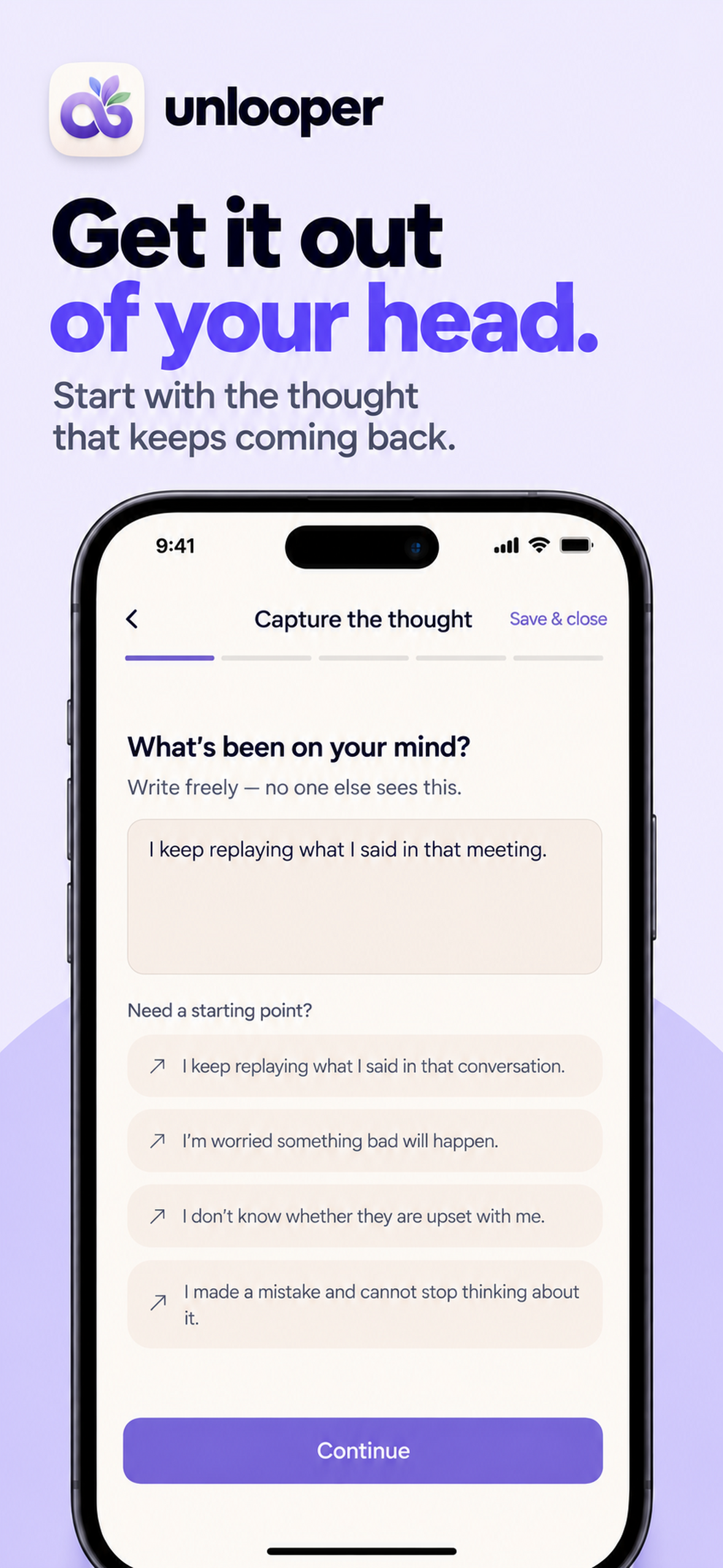
unLooper is designed for exactly these moments. The Overthinking Breaker is a guided session of about three minutes that starts by capturing the thought, separates fact from fear, helps you find other angles, and ends on one small doable step, much like the 3-minute reset above.
For evenings, Quiet Mind at Night combines a bedtime brain-dump with breathing and grounding. Mood check-ins let you notice which situations trigger the most overthinking. Reflections stay private on your device, with no ads.
When to get help
If racing thoughts are persistent, disrupt your daily life, or come with thoughts of self-harm, please talk to a doctor or licensed mental-health professional. In the US, you can call or text 988 to reach the Suicide & Crisis Lifeline.
The bottom line
You can calm your mind from overthinking fast by working with your body and your attention instead of fighting your thoughts. Breathe with a long exhale, capture the thought, label it, use your name, ground in your senses, and take one tiny step. Three minutes is often enough to turn a spiral into a next move.
Frequently asked questions
How can I calm my mind in 5 minutes?
Spend two minutes on slow breathing with a longer exhale, one minute writing the thought down in a single line, one minute grounding through your senses, and one minute choosing a small next step. That combination interrupts the loop and gives your mind somewhere to go.
What is the fastest way to stop overthinking?
There is no instant off switch, but slow breathing is one of the quickest tools, and research links it to reduced arousal. Pairing it with writing the thought down helps because your mind no longer has to keep holding it.
Why does overthinking make my body feel tense?
Repetitive worry can keep your body in a mild stress state, with faster breathing and muscle tension. Calming the body through breathing and movement often helps calm the thoughts too, because the two influence each other.
Do these techniques work during a stressful moment at work?
Yes, most are invisible. Slow breathing, grounding through your senses, and silently using your own name can all be done at a desk or in a meeting without anyone noticing.

Fahd Chouki is an independent developer and the founder of unLooper. He writes practical guides on overthinking, sleep and decision-making, summarizing published research into steps you can use the same day.
How we write: every guide is based on peer-reviewed research listed in the sources, reviewed for accuracy and updated when evidence changes.
Sources & further reading
- Zaccaro, A., et al. (2018). How breath-control can change your life: A systematic review on psycho-physiological correlates of slow breathing. Frontiers in Human Neuroscience, 12, 353. doi:10.3389/fnhum.2018.00353
- Kross, E., & Ayduk, O. (2011). Making meaning out of negative experiences by self-distancing. Current Directions in Psychological Science, 20(3), 187–191. doi:10.1177/0963721411408883
- Wegner, D. M., Schneider, D. J., Carter, S. R., & White, T. L. (1987). Paradoxical effects of thought suppression. Journal of Personality and Social Psychology, 53(1), 5–13. doi:10.1037/0022-3514.53.1.5
This article is for general information and self-reflection. It is not medical advice and does not replace a doctor or licensed mental-health professional.