How to Get Over a Bad Decision (Without Replaying It Forever)
To get over a bad decision, separate the quality of the choice from the outcome, name what you actually knew at the time, extract one lesson, and take one small repair step. Then stop the replay by giving regret a set time slot instead of letting it run all day.
You made a call, it went badly, and now your mind keeps rewinding the tape. Maybe it was a job you accepted, money you spent, or something you said that you cannot take back. Every replay ends the same way, and yet you keep pressing play.
This guide walks you through a practical way to process the decision, learn what is worth learning, and actually let it go.
Why a bad decision keeps replaying in your head
Regret is designed to be sticky. It flags a gap between what happened and what could have happened, and your brain tries to close that gap by rerunning the scenario. The problem is that the past cannot be edited, so the loop never gets the ending it wants.
Research on rumination backs this up. A 2008 review by Nolen-Hoeksema, Wisco and Lyubomirsky concluded that rumination tends to impair problem solving and prolong distress. In other words, replaying the decision feels like you are working on it, but it usually keeps you stuck.
There is also a timing twist. Gilovich and Medvec (1995) found that in the short term people tend to regret actions they took, while over the long term they more often regret the things they did not do. So the sharp sting you feel right now about something you did is common, and it often softens with time.
Bad decision or bad outcome? Check this first
Before you judge yourself, separate two things that get mixed up constantly: the quality of the decision and the quality of the outcome. A good decision can lead to a bad result because of luck, timing, or information nobody had. A poor decision can occasionally work out fine.
Ask yourself honestly:
- What did I actually know at the time, not what I know now?
- Did I have reasonable options I ignored?
- Was I rushed, exhausted, or pressured into it?
- Would a sensible friend, with the same information, have chosen similarly?
If the answers suggest you made a reasonable call with what you had, the outcome was bad luck, not bad judgment. If you skipped steps you normally take, that is useful information, and it becomes your lesson.
How to get over a bad decision in 7 steps
1. Write down what happened in plain facts
Describe the decision and its consequences in three or four neutral sentences, as if you were writing a news report. No adjectives like stupid, careless, or disaster. Facts only.
This matters because the story in your head is usually bigger than the facts. Seeing it on paper shrinks it to its real size.
2. Separate fact from fear
Draw two columns. On the left, list what has actually happened. On the right, list what you fear will happen because of it. Most people find the right column is much longer and full of guesses.
You only need to respond to the left column today. The right column is a list of possibilities, not events.
3. Step back and look from a distance
Kross and Ayduk (2011) describe self-distancing: reflecting on your situation as if you were an observer, or even referring to yourself in the third person. Their research suggests this can reduce emotional reactivity and rumination.
Try it: "Sara made a decision with the information she had. What would I tell Sara now?" You will likely find you are much kinder and more practical with her than with yourself.
4. Ask "how" questions, not "why me" questions
Watkins (2008) distinguished between constructive and unconstructive repetitive thought. Abstract, evaluative questions such as "Why do I always mess things up?" tend to keep people stuck. Concrete, process-focused questions such as "What specifically happened at the moment I chose?" tend to be more helpful.
Swap your questions:
- "Why am I so bad at this?" becomes "Which step did I skip?"
- "How could I be so stupid?" becomes "What was I missing, and how could I get it next time?"
5. Extract one lesson, just one
Lessons are the useful part of regret. But a list of fifteen lessons is just rumination wearing a different outfit. Pick the single most useful takeaway and write it as a rule for next time.
For example: "Before signing any contract over $1,000, I wait 48 hours and ask one person to read it."
6. Take one repair step
Getting over a bad decision is far easier when you do something about it. Ask: what is one small action, doable this week, that reduces the damage or moves me forward? Send the apology. Call the company about a return. Update your resume. Open a savings note to rebuild the money.
Small is fine. The point is to give your brain proof that you are no longer stuck in the moment of the mistake.
7. Give regret a time slot
If the thoughts keep coming back, schedule them. Set aside 10 to 15 minutes in the early evening to think about the decision on purpose. When it pops up at other times, note it and tell yourself, "Not now, at 6 pm." This mirrors the worry-period approach covered in our guide on how to stop ruminating.
Worked example: the apartment you regret signing
Let us run the steps on a real-feeling scenario.
The decision: You signed a one-year lease on an apartment that turned out to be noisy, and your commute doubled. You keep thinking, "I ruined my year."
Facts: I signed a 12-month lease. The apartment is louder than expected. My commute is 50 minutes instead of 25.
Fears: I will never sleep well. I wasted thousands. My partner thinks I have bad judgment. I will be stuck forever.
Decision quality check: I viewed it once, at noon on a Sunday. I felt pressure because two other people were interested. I did not check the commute at rush hour.
Distanced view: "Alex was under time pressure in a competitive market and chose a place that looked good. That is understandable."
One lesson: "For future rentals I will visit twice, once on a weekday evening, and test the commute at rush hour."
One repair step: Buy a white-noise machine and ask the landlord whether early lease transfer is possible.
Notice how the decision shrinks from "I ruined my year" to "a frustrating year with two fixes in progress." That shift is what moving on looks like.
Copy-ready template: the bad decision reset
Use this whenever a past choice will not leave you alone:
- What happened (facts only):
- What I am afraid it means:
- What I knew at the time:
- Was it a bad decision or a bad outcome?
- What I would tell a friend in my place:
- My one lesson, written as a rule:
- My one repair step this week:
- When I will think about this on purpose (time slot):
Fill it in once, then reread it instead of re-thinking the whole thing every time the regret flares.
What if the decision cannot be undone?
Some decisions are permanent. You cannot unsay the words or un-sell the house. In those cases, getting over it means accepting what is fixed and redirecting effort to what is not.
A useful question is: "Given that this happened, what is the best next decision I can make?" That moves you out of the past and into a choice you can still influence. If you tend to second-guess yourself after every choice, our article on how to know if you made the right decision offers a calmer way to evaluate choices as they unfold.
And if this experience has made you wary of deciding at all, it may help to read about how to make a decision when you can't decide so that the next choice feels structured instead of scary.
How unLooper can help
unLooper is a self-reflection app built for exactly this kind of loop. The Overthinking Breaker is a guided session of about three minutes that walks you through separating fact from fear, finding other angles on what happened, and ending on one small doable step, which mirrors steps 2, 3 and 6 above.
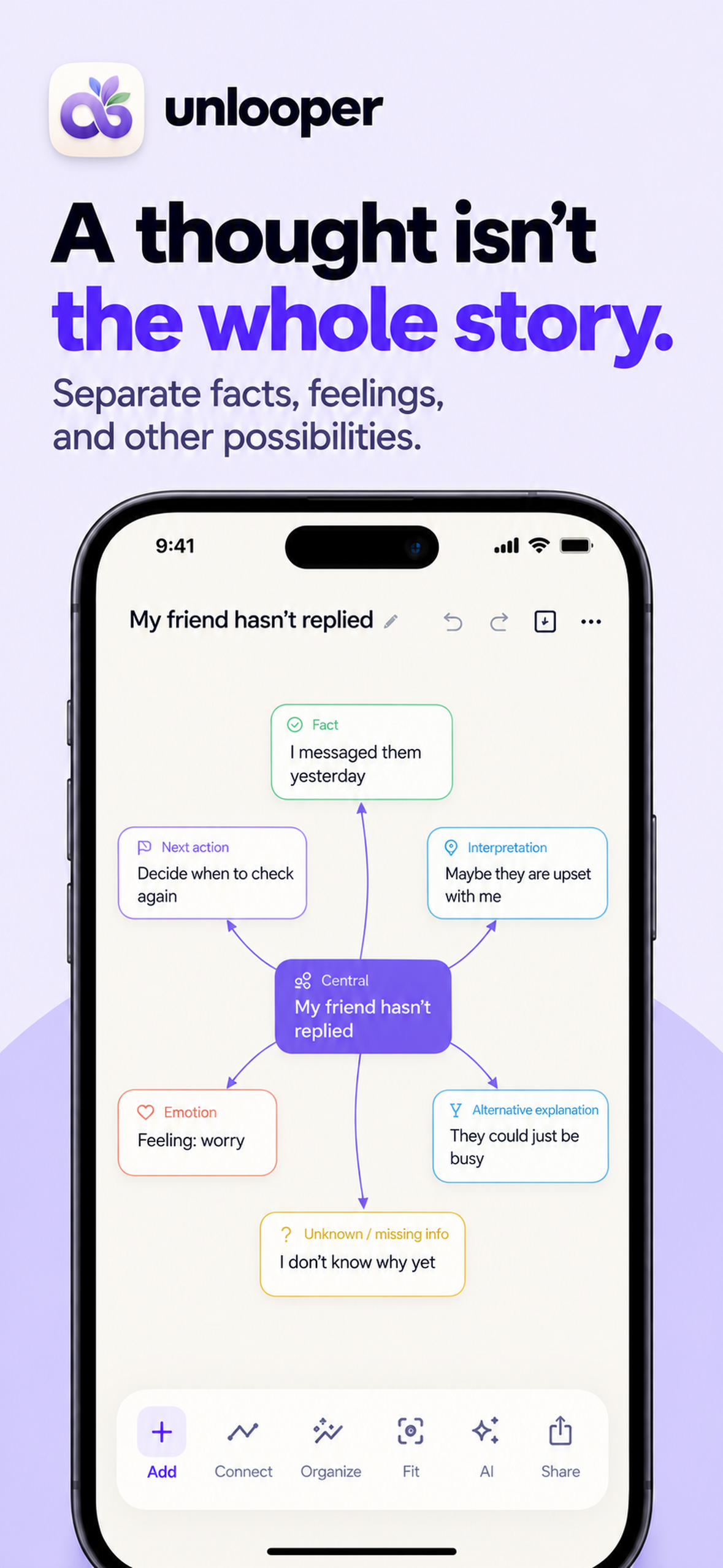
If the decision is tangled up with several worries, an AI thought map can help you lay out the facts, fears, and lessons in one editable view, while you stay in control of what goes on it. And when the next choice comes, Decide for me lets you weigh options against what matters to you before committing. Reflections stay on your device, and there are no ads.
When to get help
If regret about a decision is persistent, disrupts your sleep, work, or relationships, or comes with thoughts of harming yourself, please talk to a doctor or a licensed mental-health professional. In the US, you can call or text 988 to reach the Suicide & Crisis Lifeline at any time.
The bottom line
A bad decision is an event, not an identity. Check whether it was a bad choice or just a bad outcome, step back and look at it like a friend would, keep one lesson, and take one repair step. Then let the time slot hold the rest. For a broader toolkit, see our guide on how to stop overthinking everything.
Frequently asked questions
Why can't I stop thinking about a bad decision?
Your mind keeps replaying a decision because it is trying to solve a problem that is already in the past. Replaying feels productive, but research on rumination suggests it usually prolongs distress rather than producing answers. Turning the replay into one concrete lesson and one action gives your brain a way to close the loop.
How long does it take to get over a bad decision?
There is no fixed timeline. Small decisions often fade within days once you take a repair step, while big ones such as a career move or a breakup can take months. What tends to speed things up is shifting from asking why it happened to asking what you will do next.
Is it normal to regret a big decision even if it was right?
Yes. Almost every meaningful choice involves giving something up, so some regret is normal even when the decision was sound. Regret is a signal about what you value, not proof that you chose wrong.
Should I try to undo a bad decision?
Sometimes. If the decision is reversible and the cost of reversing is lower than the cost of staying, undoing it can be wise. If it is not reversible, focus your energy on reducing the damage and building the next better option.

Fahd Chouki is an independent developer and the founder of unLooper. He writes practical guides on overthinking, sleep and decision-making, summarizing published research into steps you can use the same day.
How we write: every guide is based on peer-reviewed research listed in the sources, reviewed for accuracy and updated when evidence changes.
Sources & further reading
- Gilovich, T., & Medvec, V. H. (1995). The experience of regret: What, when, and why. Psychological Review, 102(2), 379–395. doi:10.1037/0033-295X.102.2.379
- Kross, E., & Ayduk, O. (2011). Making meaning out of negative experiences by self-distancing. Current Directions in Psychological Science, 20(3), 187–191. doi:10.1177/0963721411408883
- Watkins, E. R. (2008). Constructive and unconstructive repetitive thought. Psychological Bulletin, 134(2), 163–206. doi:10.1037/0033-2909.134.2.163
- Nolen-Hoeksema, S., Wisco, B. E., & Lyubomirsky, S. (2008). Rethinking rumination. Perspectives on Psychological Science, 3(5), 400–424. doi:10.1111/j.1745-6924.2008.00088.x
This article is for general information and self-reflection. It is not medical advice and does not replace a doctor or licensed mental-health professional.