How to Make Big Life Decisions Without Losing Sleep Over Them
To make big life decisions, start by naming what you value most, check how reversible each option is, gather only the information that would change your mind, and imagine both your future regret and how the choice could fail. Then set a decision date, commit, and plan the first concrete step.
Should you move to another city? Leave the job? End the relationship, start the business, go back to school, have a child? Big life decisions are hard because they combine high stakes, real uncertainty, and choices that are difficult to reverse.
It is no wonder they keep you up at night. This guide gives you a calm, structured way to work through them, so you can decide and then actually live with your choice.
Why big life decisions feel so paralyzing
Small decisions are easy to make because the downside is small. Big ones feel different for a few reasons:
- They are hard to undo. Moving across the country or quitting a stable job cannot be reversed with a click.
- They involve identity. The choice can feel like a statement about who you are.
- Other people are affected. Partners, children, parents, and colleagues all have a stake.
- The future is uncertain. You are choosing between two unknowns, not between a known and an unknown.
The goal is not to remove uncertainty. It is to make the best choice you can with what you know, and to be at peace with having made it.
How to make big life decisions: 8 steps
1. Define the decision clearly
Write the decision as a single question. "Should I accept the job in Denver by May 1?" is far more workable than "What should I do with my life?"
Then list the real options. Often there are more than two. Instead of "stay or leave," there may be "stay and renegotiate," "leave in six months," or "take a leave of absence."
2. Name what you value most
Before comparing options, write the five things that matter most to you in this area of life. For a career move, that might be growth, income, family time, location, and meaning.
Rank them. Big decisions often come down to which value you are willing to put first for the next few years.
3. Check how reversible each option is
Ask for each option: "If this goes badly, how hard is it to undo, and what would it cost?" A decision that is reversible within a year is a very different bet from one that is permanent.
Reversible options deserve less deliberation. You can try them and adjust. Irreversible options deserve more time, more information, and more advice.
4. Gather the information that would change your mind
More research is not always better. Ask: "What one or two facts, if I learned them, would change my decision?" Then go find those facts. Talk to someone who made the same move. Visit the city. Ask the employer about the team.
Stop gathering once new information stops shifting your view. Past that point, research is usually a way of postponing.
5. Weigh the options against your values
Score each option against the values from step 2. A weighted decision matrix works well here. Give each value a weight, score each option, and total the results. Our guide on how to make a decision matrix walks through it step by step.
The point is not to let a number decide. It is to see clearly where the trade-offs are.
6. Imagine your future regret
Gilovich and Medvec (1995) found that in the short term people tend to regret actions more, but in the long term they tend to regret inactions more: the chances they did not take, the things they never tried.
Try this: imagine yourself at 80, looking back. Which choice would you be more likely to regret not making? This does not mean always choosing the bolder option. It means weighing long-term regret, not just short-term fear.
7. Run a premortem on your leading option
Klein (2007) described the premortem: imagine the decision has already been made and has failed, then list the reasons why. For a big life decision, picture it is two years from now and the move was a mistake. What went wrong?
Maybe it was loneliness, money, or a role that did not match the description. Each reason becomes a risk you can plan for now, or a sign that another option is safer.
8. Set a decision date, decide, and plan the first step
Pick a date and commit to deciding by then. Endless deliberation has its own cost. Schwartz and colleagues (2002) found that maximizers, people who insist on finding the very best option, reported less satisfaction and more regret than satisficers, who choose an option that is good enough. For big decisions, aim for a choice that is sound, not perfect.
Once you decide, write an implementation intention. Gollwitzer (1999) reviewed research showing that if-then plans ("If it is Monday morning, then I will email my manager") improve follow-through. A specific first step turns a big decision into motion.
Worked example: moving to a new city for a job
Decision: Should I accept the job offer in Austin and move by September, or stay in Chicago?
Options: Accept and move. Stay. Ask for a remote arrangement.
Top values (ranked): 1) career growth, 2) being near family, 3) financial stability, 4) lifestyle, 5) friendships.
Reversibility: Moving is reversible in about a year, at a cost of roughly two months of savings. Staying is easily reversible because other offers may come.
Information that would change my mind: Whether the team in Austin is stable, and whether remote work is an option. I ask both questions.
Matrix result: Move scores 74, remote arrangement 71 (if offered), stay 58.
Future regret: At 80, I would likely regret not trying the role more than trying and coming back.
Premortem: If the move failed, it would be because of isolation and missing family. Plan: book flights home every two months and join one club in the first month.
Decision date: Friday. First step: If it is Friday 9 am, then I will email my acceptance and ask about relocation support.
Copy-ready template: the big decision worksheet
- The decision as one question (with deadline):
- All my real options (not just two):
- My top five values, ranked:
- For each option, how reversible is it, and at what cost?
- The one or two facts that would change my mind:
- Matrix totals (or quick ranking):
- At 80, which choice would I regret not making?
- Premortem: if my leading option failed, why?
- My plan for those risks:
- Decision date:
- First step, as if-then: If _, then I will _.
After you decide
The hardest part of a big decision is often the second-guessing that follows. Expect it. Doubt is not proof you chose wrong; it is the normal feeling of having closed a door. Our article on how to know if you made the right decision can help you evaluate your choice fairly over time. And if the choice does go sideways, how to get over a bad decision covers how to recover without endless regret.
If you are still frozen at the start, how to make a decision when you can't decide is a good place to begin.
How unLooper can help
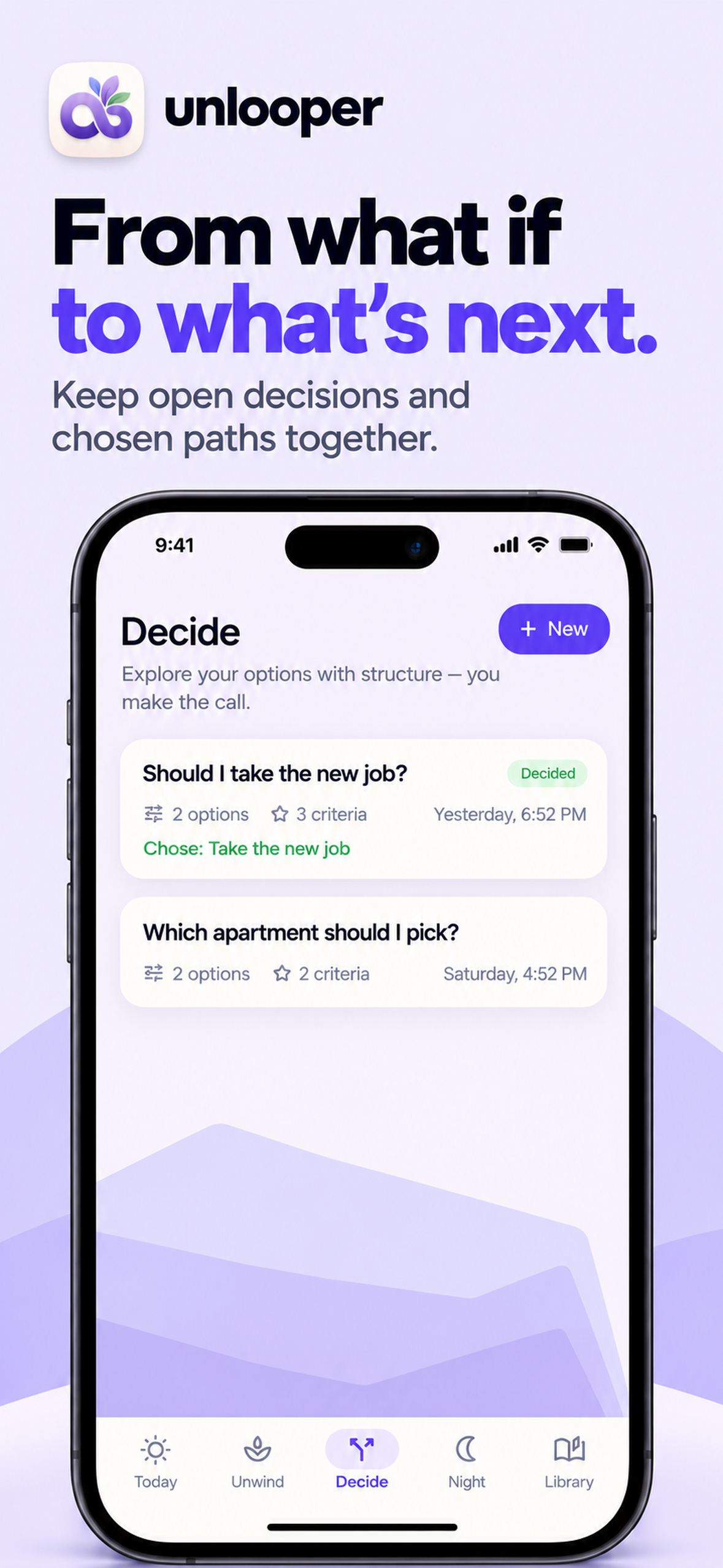
unLooper's Decide for me lets you weigh your options against weighted criteria that reflect your values, then get an honest AI review of the trade-offs before you make the call yourself. It mirrors steps 2, 5, and 7 above.
When a big decision comes with a flood of worries, the Overthinking Breaker offers a guided session of about three minutes that separates fact from fear and ends on one small doable step. AI thought maps can help you lay out everything the decision touches in one editable view. Your reflections stay private on your device, with no ads.
When to get help
If a major decision is causing persistent distress, disrupting your sleep or daily life, or comes with thoughts of self-harm, please talk to a doctor or licensed mental-health professional. In the US, you can call or text 988 to reach the Suicide & Crisis Lifeline.
The bottom line
Big life decisions do not require certainty. They require clarity about your values, honesty about reversibility, a look at future regret and possible failure, and a date to commit. Decide, take the first step, and let the next chapter teach you the rest.
Frequently asked questions
How do you know when you are ready to make a big decision?
You are usually ready when new information has stopped changing your view, you can explain the main trade-offs in a sentence or two, and you have a plan for the most likely risks. Waiting for total certainty usually means waiting forever.
Should I follow my head or my heart on a major life decision?
Use both. Structured analysis helps you see trade-offs clearly, and your emotional reaction tells you what you care about. If they disagree, explore why before choosing, because the gap often reveals a missing factor.
How long should a big life decision take?
Long enough to gather key information and sleep on it, but with a deadline. For most major choices, a few days to a few weeks is reasonable. Setting a decision date prevents endless deliberation.
What if I regret my big decision later?
Some regret is normal with any meaningful choice because every path involves giving something up. Research suggests that over the long run people tend to regret the things they did not do more than the things they did. Focus on what you can do next rather than replaying the choice.

Fahd Chouki is an independent developer and the founder of unLooper. He writes practical guides on overthinking, sleep and decision-making, summarizing published research into steps you can use the same day.
How we write: every guide is based on peer-reviewed research listed in the sources, reviewed for accuracy and updated when evidence changes.
Sources & further reading
- Gilovich, T., & Medvec, V. H. (1995). The experience of regret: What, when, and why. Psychological Review, 102(2), 379–395. doi:10.1037/0033-295X.102.2.379
- Klein, G. (2007). Performing a project premortem. Harvard Business Review, 85(9), 18–19.
- Schwartz, B., Ward, A., Monterosso, J., Lyubomirsky, S., White, K., & Lehman, D. R. (2002). Maximizing versus satisficing: Happiness is a matter of choice. Journal of Personality and Social Psychology, 83(5), 1178–1197. doi:10.1037/0022-3514.83.5.1178
- Gollwitzer, P. M. (1999). Implementation intentions: Strong effects of simple plans. American Psychologist, 54(7), 493–503. doi:10.1037/0003-066X.54.7.493
This article is for general information and self-reflection. It is not medical advice and does not replace a doctor or licensed mental-health professional.