How to Stop Overthinking About Someone (Crush, Ex, or Friend)
To stop overthinking about someone, do not try to force the thoughts away, because suppression makes them rebound. Instead, write the thoughts out once, separate what you know from what you are guessing, give the topic a scheduled slot, and redirect to one concrete action or activity each time it returns.
They took longer than usual to reply. Or they said something ambiguous. Or it ended months ago and they still show up in your head every hour. Whether it is a crush, an ex, a friend, or a coworker, overthinking about someone can quietly take over your day.
The good news is that you do not need to stop caring to stop overthinking. You just need a better way to handle the thoughts when they arrive.
Why you keep thinking about the same person
People occupy a lot of mental space when something about them feels unresolved. An unanswered text, mixed signals, a sudden goodbye, or a conflict that never got closure all create an open loop. Your mind keeps checking the loop, hoping to find the missing piece.
Three things usually feed the cycle:
- Uncertainty: you do not know how they feel or what will happen.
- Interpretation: you replay their words and look for hidden meaning.
- Checking: profiles, old messages, and online status give you new material to analyze.
Why "just stop thinking about them" backfires
The most common advice is the least helpful. In the famous white bear study, Wegner and colleagues (1987) asked people not to think about a white bear. Participants who tried to suppress the thought ended up thinking about it more afterward, a rebound effect.
So if you have been telling yourself "stop thinking about them" a hundred times a day, the effort itself may be keeping them on your mind. The steps below work with your attention instead of against it.
How to stop overthinking about someone: 8 steps
1. Get the thoughts out of your head, once
Take ten minutes and write everything you are thinking about this person: what happened, what you wish had happened, what you fear, what you hope. Do not edit.
Pennebaker (1997) reviewed research on expressive writing and found that writing about emotional experiences has been linked to a range of benefits. Putting the swirl into words also makes it finite. It stops being an endless cloud and becomes a page you can look at.
2. Sort known facts from guesses
Go back through what you wrote and mark each line as F (fact) or G (guess). "She has not replied in six hours" is a fact. "She is losing interest" is a guess.
Most overthinking about people lives in the G lines. You cannot act on a guess, but you can act on a fact, or decide to gather more facts.
3. Generate three other explanations
For your biggest guess, write three alternative explanations. If he did not reply, maybe he is busy at work, maybe his phone is dead, maybe he is not sure what to say either. You do not need to believe them. You just need to see that your first story is not the only one.
4. Look at it from a distance
Kross and Ayduk (2011) found that self-distancing, viewing your situation as if from the outside or talking to yourself in the third person, can reduce emotional reactivity and rumination. Ask: "If my best friend described this exact situation to me, what would I tell them?"
Distance usually turns "this is a catastrophe" into "this is an awkward, normal human moment."
5. Decide if there is something to do
Every loop about another person ends in one of three places:
- Act: ask a clear question, apologize, set a boundary, or make a plan.
- Wait: the next move is theirs, and you choose a date to revisit.
- Release: there is nothing to do, and holding on only costs you.
Pick one. Writing the choice down gives your mind a reason to stop circling.
6. Schedule a "them" slot
Borkovec and colleagues (1983) tested a scheduled worry period: people postponed worries to a set daily time and place. This approach reduced worry. You can borrow the idea. Give yourself 15 minutes a day to think about this person deliberately. When thoughts arrive at other times, jot a word down and say, "Later, in my slot."
You are not suppressing the thought. You are postponing it, which is very different.
7. Reduce the triggers you control
Checking their profile, rereading old chats, or watching their stories feeds the loop new details. Mute, archive, or move the app off your home screen for two weeks. This is not dramatic; it is just removing fuel.
8. Redirect, do not resist
When the thought comes back, notice it, label it ("there is the thought about Sam again"), and turn your attention to something concrete: a walk, a task you can finish in ten minutes, a call with a friend. Over time, the label alone starts to loosen the pull.
Worked example: the unanswered message
Situation: You texted someone you have been dating, "Had a great time last night." Eight hours later, no reply.
Brain dump (excerpt): "They did not enjoy it. I said too much. I should not have texted first. They are talking to someone else."
Facts vs guesses: Fact: no reply for eight hours. Fact: they said they had a busy week. Everything else: guess.
Three other explanations: They are swamped at work. They saw it and plan to reply properly later. They are someone who does not text much.
Distanced view: "Jordan sent a kind, normal message. A delay of eight hours does not mean rejection."
Decision: Wait. If there is no reply in two days, send one light, clear message. Then release.
Redirect: Finish the laundry and call a friend.
The situation did not change. Your relationship to the thought did.
Copy-ready template: the person-loop checklist
Next time someone takes over your head, run this:
- ☐ I wrote the thoughts down once (10 minutes, no editing).
- ☐ I marked each thought as fact or guess.
- ☐ I wrote three other explanations for my biggest guess.
- ☐ I asked what I would tell a friend.
- ☐ I chose: act, wait, or release.
- ☐ I set my daily slot (time: ____).
- ☐ I removed one trigger (app, chat, profile).
- ☐ I picked one redirect activity for when the thought returns.
If the loop is about a decision regarding the relationship itself, such as whether to stay or go, our guide on how to make big life decisions may help. And if the thoughts are mostly about how things ended, see how to stop overthinking the past.
When it hits hardest at night
Many people find that thoughts about someone get louder once the lights go out. If that is you, a short brain dump before bed can help. We cover the method in detail in our brain dump before bed guide, and our article on how to stop overthinking at night offers a full wind-down routine.
How unLooper can help
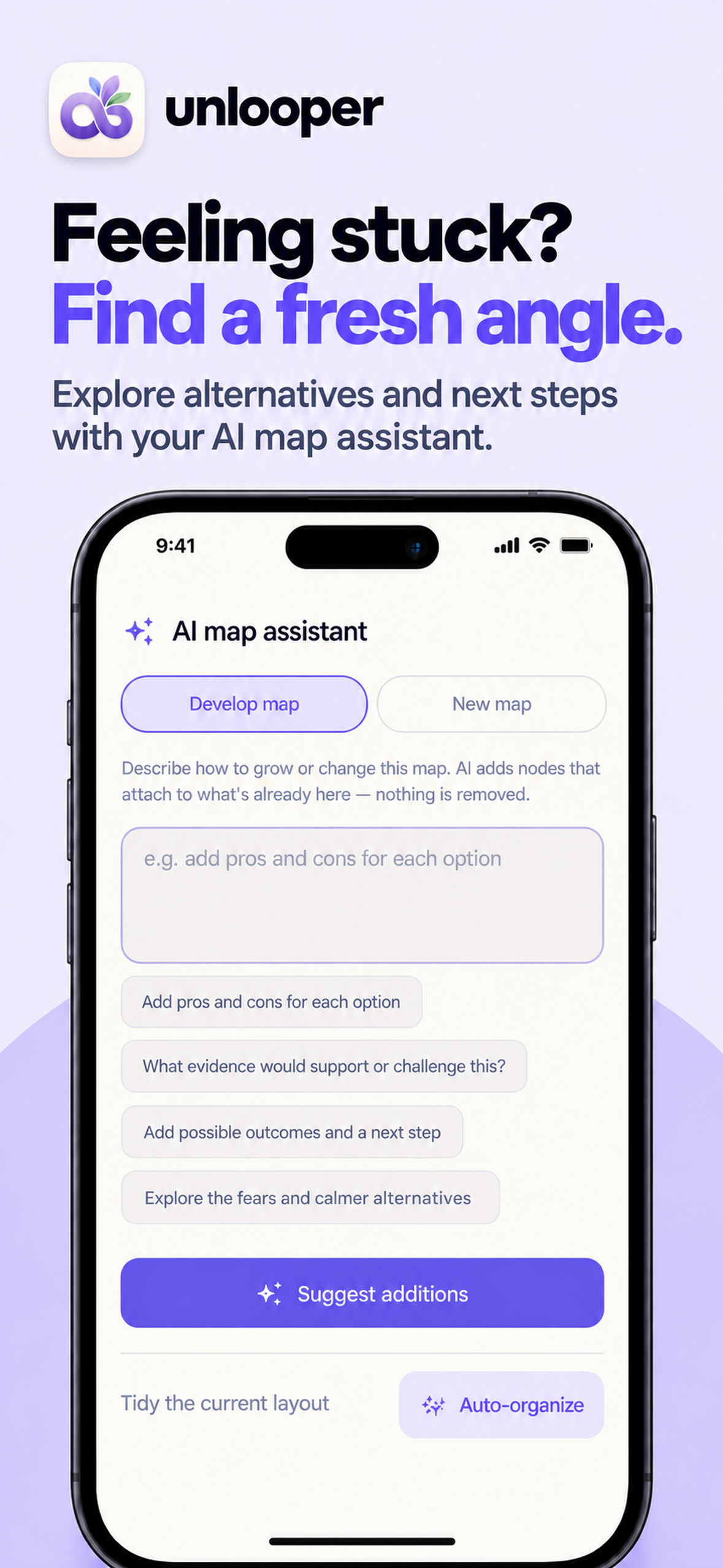
When thoughts about someone are a tangle of facts, guesses, hopes, and fears, it helps to see them laid out. In unLooper, an AI thought map turns that tangle into an editable map. The AI assistant can organize what you wrote into branches, such as what you know, what you are assuming, and what you could do, or draft a new map you then adjust. You stay in control of every node.
The Overthinking Breaker offers a guided session of about three minutes that separates fact from fear and ends on one small step. Your reflections stay private on your device, with no ads.
When to get help
If thoughts about someone are persistent, disrupt your daily life, or come with thoughts of self-harm, please talk to a doctor or licensed mental-health professional. In the US, you can call or text 988 to reach the Suicide & Crisis Lifeline.
The bottom line
You stop overthinking about someone not by forcing them out of your head, but by giving the thoughts a structure: write, sort, step back, decide, schedule, and redirect. The person may still cross your mind. They just will not run it.
Frequently asked questions
Why can't I stop thinking about someone?
Unanswered questions, strong emotions, and uncertainty keep a person on your mind. Your brain treats the open loop as unfinished business and keeps returning to it. Trying hard not to think about them can make it worse, as research on thought suppression shows.
Is it normal to overthink a text from someone?
Very normal. Short messages carry little tone, so the mind fills the gaps, usually with the worst reading. Treat your interpretation as one guess among several and, if it matters, ask a simple direct question instead of decoding.
How do I stop thinking about my ex?
Reduce the triggers you control, such as checking their profiles, and give the thoughts a short daily slot instead of fighting them all day. Writing about the relationship once, honestly, can help you process it, and building new routines gives your attention somewhere else to go.
Does thinking about someone constantly mean I love them?
Not necessarily. Frequent thoughts often reflect uncertainty or unresolved feelings rather than the strength of a bond. It can be helpful to notice whether the thoughts are mostly hopeful, anxious, or about what went wrong.

Fahd Chouki is an independent developer and the founder of unLooper. He writes practical guides on overthinking, sleep and decision-making, summarizing published research into steps you can use the same day.
How we write: every guide is based on peer-reviewed research listed in the sources, reviewed for accuracy and updated when evidence changes.
Sources & further reading
- Wegner, D. M., Schneider, D. J., Carter, S. R., & White, T. L. (1987). Paradoxical effects of thought suppression. Journal of Personality and Social Psychology, 53(1), 5–13. doi:10.1037/0022-3514.53.1.5
- Kross, E., & Ayduk, O. (2011). Making meaning out of negative experiences by self-distancing. Current Directions in Psychological Science, 20(3), 187–191. doi:10.1177/0963721411408883
- Pennebaker, J. W. (1997). Writing about emotional experiences as a therapeutic process. Psychological Science, 8(3), 162–166. doi:10.1111/j.1467-9280.1997.tb00403.x
- Borkovec, T. D., Wilkinson, L., Folensbee, R., & Lerman, C. (1983). Stimulus control applications to the treatment of worry. Behaviour Research and Therapy, 21(3), 247–251. doi:10.1016/0005-7967(83)90206-1
This article is for general information and self-reflection. It is not medical advice and does not replace a doctor or licensed mental-health professional.