Brain Dump Before Bed: A Step-by-Step Method With Templates
A brain dump before bed means writing everything on your mind onto paper for about 5 to 10 minutes, then sorting it into tasks for tomorrow and feelings for tonight. Research suggests writing a specific to-do list before sleep may help you fall asleep faster, because your brain no longer has to hold it.
Your head feels full: groceries, an unanswered email, your sister's birthday, a vague worry about money, a meeting you're not ready for. None of it is urgent at 10pm, yet all of it seems to want your attention the moment you lie down.
A brain dump before bed is one of the simplest ways to empty that mental inbox. This guide shows you exactly how to do it, why it seems to work, and gives you templates you can copy tonight.
What is a brain dump, and why do it before bed?
A brain dump is a short, unfiltered writing session where you get everything out of your head and onto paper. Then you sort it. Done before bed, it helps you close the day so your mind doesn't try to keep track of open items while you're trying to fall asleep.
The idea has some research behind it. In a 2018 sleep-lab study, Michael Scullin and colleagues asked one group to spend five minutes writing a to-do list for the next few days, and another group to write about tasks they had already completed. The to-do group fell asleep faster, and the more specific their lists, the faster they tended to fall asleep. The authors suggested that writing tasks down may help offload them from your mind, so they stop circling.
Expressive writing research points in a similar direction more broadly. In a 1997 paper, James Pennebaker summarised work linking writing about emotional experiences with a range of benefits. A bedtime brain dump is lighter than that kind of writing, but it borrows the same principle: putting thoughts into words can make them easier to handle.
How to do a brain dump before bed: the 10-minute method
You'll need a notebook or a sheet of paper and a pen. Do this 30 to 60 minutes before you want to sleep, not in bed if you can avoid it.
Step 1: Dump everything for 3–5 minutes
Set a timer. Write down every single thing on your mind, in any order, in short phrases. Don't organise, don't judge, don't write full sentences.
Include tasks ("book dentist"), worries ("is my job safe?"), reminders ("buy milk"), feelings ("annoyed at Alex"), ideas ("weekend trip?"). If you run dry, use the prompts further down.
Step 2: Sort into four groups
Go through your list and mark each item with a letter:
- T – Tomorrow: tasks you can act on in the next day or two.
- L – Later: things that matter but not this week.
- F – Feelings: emotions or worries that aren't really tasks.
- X – Let go: things you can't influence or that don't actually need anything.
This sorting step is where most of the relief comes from. Many items that felt urgent turn out to be L or X.
Step 3: Make "Tomorrow" items specific
Vague tasks keep your mind busy because it doesn't know what "done" looks like. Rewrite each T item as a concrete action. Following Scullin's finding that specific lists were linked to faster sleep onset, aim for detail.
- Vague: "Deal with taxes."
- Specific: "Download last year's tax form and put it in the 'Taxes' folder, 10am."
Step 4: Add one if-then plan for the hardest item
Pick the item you're most likely to avoid and write an implementation intention. Peter Gollwitzer's 1999 review found that "if X, then I will Y" plans tend to improve follow-through.
- "If it's 9am and I've finished my coffee, then I'll call the dentist before opening email."
Step 5: Give feelings one sentence each
For each F item, write one honest sentence that names the feeling, and then a gentle closing line. You're not solving it, just acknowledging it.
- "I'm hurt Alex didn't ask how my interview went. I can mention it to him this weekend."
- "I'm anxious about money. I've got a plan to check the budget on Saturday."
Step 6: Close the notebook
Write a closing phrase at the bottom: "Everything's written down. Tomorrow-me will handle it." Close the notebook and leave it somewhere visible for the morning. This is your signal that the day is done.
Worked example: a real-looking brain dump
Raw dump (3 minutes): email Priya re: budget, dentist overdue, worried about the reorg, mom's birthday Sunday, gym?, laptop is slow, did I lock the car, feel behind on everything, renew passport, Alex comment at dinner
Sorted:
- T: email Priya re: budget; buy mom's gift; check car is locked (now, 30 seconds)
- L: renew passport; fix slow laptop; dentist
- F: worried about reorg; feel behind; Alex comment
- X: gym? (not deciding tonight)
Specific tomorrow list:
- 9:15 – Email Priya the revised budget with the two changes she asked for.
- Lunch – Order mom's gift online (the scarf from the shop she likes).
- If I open my laptop and want to check email first, then I'll send Priya's email before anything else.
Feelings:
- "Anxious about the reorg. No news yet; I'll ask my manager in our 1:1 on Thursday."
- "Feeling behind. Most of this list is 'later', not 'now'."
Closing line: "It's all on paper."
Copy-and-use brain dump templates
Template 1: The quick version (5 minutes)
``` DUMP (3 min, no filter): - - -
TOMORROW (specific, with a time): 1. 2. 3.
FEELINGS (one line each):
CLOSE: "Everything's written down." ```
Template 2: The full version (10 minutes)
1. Everything on my mind:
2. Sort: T (tomorrow) / L (later) / F (feelings) / X (let go)
3. Tomorrow's 3 most important actions, with times:
4. If-then plan for the hardest one:
   If ________, then I will ________.
5. Feelings, one honest sentence each:
6. One thing that went okay today:
7. Closing line:
Brain dump prompts when your mind goes blank
If you stall during Step 1, read through these slowly:
- What am I worried I'll forget?
- What's unfinished from today?
- Who do I need to reply to?
- What's coming up this week that I'm dreading?
- What's bothering me that I haven't said out loud?
- What decision am I avoiding?
- What would make tomorrow feel lighter?
Common brain dump mistakes
- Doing it in bed. Try a chair or kitchen table so your bed stays linked with sleep.
- Writing an essay. Keep it to phrases. Deep emotional writing is better earlier in the day.
- Skipping the sort. An unsorted list can feel overwhelming. The sort is the point.
- Making tomorrow's list too long. Three priority actions is plenty. Everything else goes to "Later".
If thoughts still show up once you're lying down, see our guide on what to do with racing thoughts at night. For a complete evening routine around the brain dump, read how to stop overthinking at night. If your daytime thoughts feel tangled too, organizing your thoughts with a thought map uses a similar principle. And if most of your dump is about what might happen, try our guide on how to stop worrying about the future.
How unLooper can help
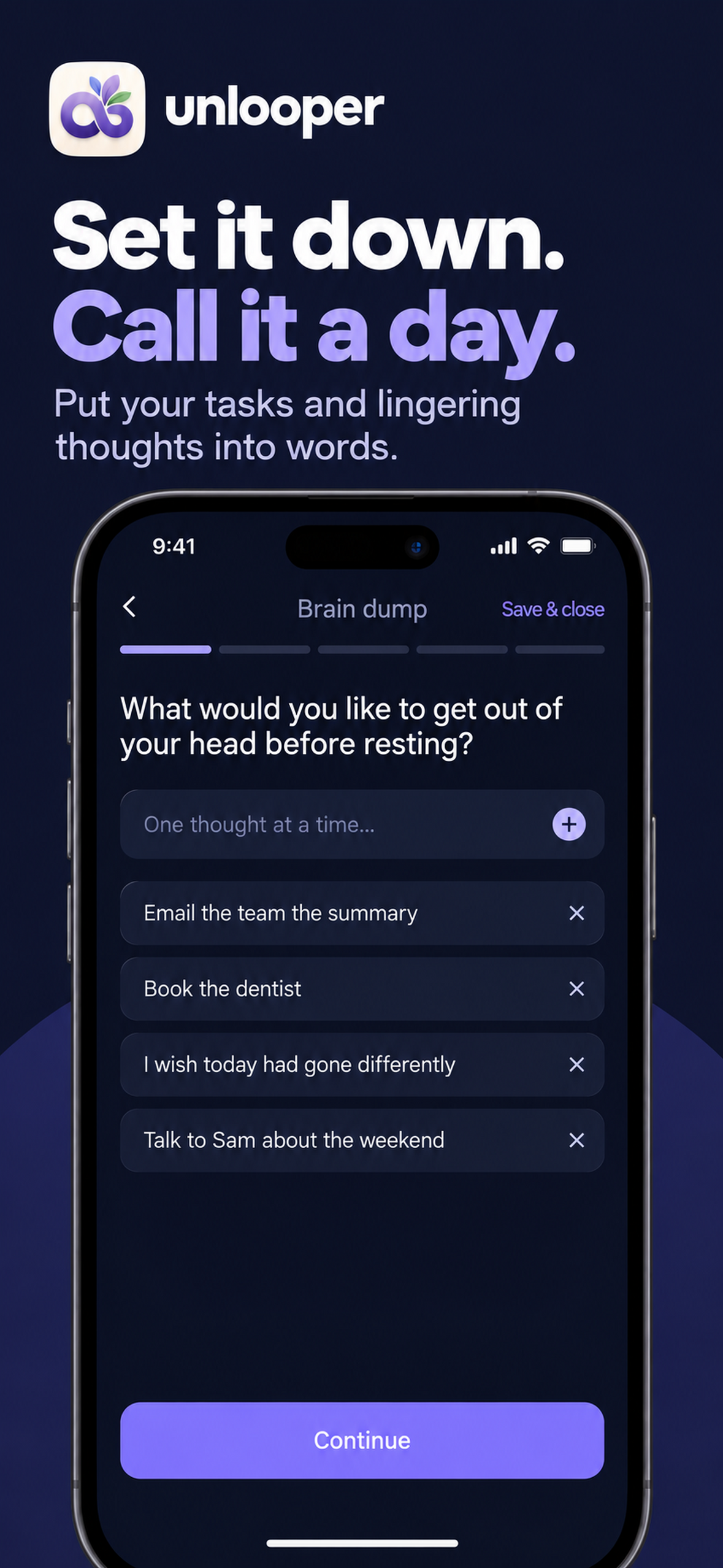
unLooper's Quiet Mind at Night turns this method into a guided routine. You start with a bedtime brain-dump, and the app helps you sort tomorrow's worries from tonight's, the same distinction as the T and F groups above. Once things are set down, it moves into slow breathing and grounding to help you wind down.
A gentle bedtime reminder can prompt you to do it at the same time each night, which makes the habit easier to keep. Your reflections are private by default and stay on your device, and there are no ads. unLooper is a self-reflection tool, not a medical service.
When to get help
If your thoughts at night are persistent, stop you from sleeping most nights, or affect how you function during the day, talk to a doctor or licensed mental health professional. If you have thoughts of harming yourself, call or text 988 in the US to reach the 988 Suicide & Crisis Lifeline.
The bottom line
A brain dump before bed takes about ten minutes: write everything down, sort it, make tomorrow's tasks specific, acknowledge your feelings and close the notebook. It won't fix every worry, but it gives each one a place to wait, so your mind has less reason to keep it on repeat while you're trying to sleep.
Frequently asked questions
What is a brain dump before bed?
It is a short writing exercise where you put every thought, task and worry on paper before sleep, without filtering. You then sort what you wrote so that tasks have a plan for tomorrow and feelings are acknowledged, which leaves less for your mind to replay in bed.
How long should a bedtime brain dump take?
Five to ten minutes is enough for most people. A 2018 sleep study used a five-minute to-do list, and longer sessions can sometimes stir up more thoughts than they settle.
Should I brain dump on paper or on my phone?
Both can work. Paper avoids screen light and notifications, which is helpful close to bedtime. If you use your phone, lower the brightness, silence notifications and close the app as soon as you are done.
What's the difference between a brain dump and journaling?
Journaling often explores feelings and experiences in depth. A brain dump is faster and more practical: capture everything, sort it, and assign next steps. At bedtime, the goal is to close the day, not to open up big emotional topics.

Fahd Chouki is an independent developer and the founder of unLooper. He writes practical guides on overthinking, sleep and decision-making, summarizing published research into steps you can use the same day.
How we write: every guide is based on peer-reviewed research listed in the sources, reviewed for accuracy and updated when evidence changes.
Sources & further reading
- Scullin, M. K., Krueger, M. L., Ballard, H. K., Pruett, N., & Bliwise, D. L. (2018). The effects of bedtime writing on difficulty falling asleep: A polysomnographic study comparing to-do lists and completed activity lists. Journal of Experimental Psychology: General, 147(1), 139–146. doi:10.1037/xge0000374
- Pennebaker, J. W. (1997). Writing about emotional experiences as a therapeutic process. Psychological Science, 8(3), 162–166. doi:10.1111/j.1467-9280.1997.tb00403.x
- Gollwitzer, P. M. (1999). Implementation intentions: Strong effects of simple plans. American Psychologist, 54(7), 493–503. doi:10.1037/0003-066X.54.7.493
This article is for general information and self-reflection. It is not medical advice and does not replace a doctor or licensed mental-health professional.