12 Signs You Are an Overthinker, and What to Do About Each
Common signs you are an overthinker include replaying conversations, struggling to make even small decisions, imagining worst-case scenarios, lying awake with racing thoughts, and seeking reassurance repeatedly. If several apply most days, your thinking has likely shifted from problem-solving to looping, and simple structured techniques can help.
You have probably been called an overthinker. Maybe you call yourself one. But where is the line between being thoughtful and being stuck in your own head?
This article lists the most common signs of chronic overthinking, gives you a quick self-check, and suggests a first step for each pattern so the list is useful rather than just familiar.
What is overthinking, really?
Thinking is useful when it moves you toward a decision, a plan, or understanding. Overthinking is what happens when thinking keeps going but stops moving. You spend more time with the problem and get no closer to an answer.
Researchers usually describe two main forms:
- Rumination: repetitive focus on the past, on what went wrong, and on your own feelings or flaws.
- Worry: repetitive focus on future threats and what might go wrong.
Watkins (2008) reviewed decades of research and found that repetitive thought can be constructive or unconstructive. Concrete, process-focused thinking tends to help. Abstract, evaluative "why me" thinking tends to keep people stuck. Most of the signs below are forms of the unhelpful kind.
12 signs you are an overthinker
1. You replay conversations long after they end
You go back over what you said, what they said, and what they might have meant. Hours or days later, you are still editing your lines.
First step: Write the conversation down once and ask, "Is there anything I actually need to do?" If not, let the written version hold it.
2. Small decisions take forever
Which restaurant, which email subject line, which shirt. You research, compare, and still feel unsure.
First step: Set a time limit for low-stakes choices (two minutes) and accept "good enough." Our guide on how to make a decision when you can't decide goes deeper.
3. You jump to the worst-case scenario
A late reply means they are angry. A headache means something serious. Your mind skips straight to disaster.
First step: For each worst case, write the best case and the most likely case. The middle one is usually the most realistic.
4. You lie awake with racing thoughts
The moment your head hits the pillow, the to-do list, worries, and memories start. Harvey (2002) described a cognitive model of insomnia in which pre-sleep worry and arousal help keep sleep problems going.
First step: Do a five-minute brain dump before bed. See our guide on how to stop overthinking at night.
5. You ask for reassurance again and again
You check with friends, partners, or search engines that things are okay, feel better briefly, then need to ask again.
First step: Notice the urge, wait 20 minutes, and ask yourself what you would tell a friend.
6. You analyze other people's every word
A text with no emoji, a short "ok," a change in tone. You decode messages like evidence.
First step: Generate three alternative explanations before settling on one. Our article on how to stop overthinking about someone has a full method.
7. You keep asking "why" about yourself
"Why am I like this? Why does this always happen to me?" These questions feel deep but rarely lead anywhere.
First step: Swap one why question for a how or what question: "What specifically happened, and what would I try next time?"
8. You struggle to be present
You are at dinner, but your mind is at tomorrow's meeting or last week's argument. People notice you are a bit far away.
First step: Name five things you can see right now. It is simple, and it pulls attention back.
9. You plan so much you never start
You have mapped every possible scenario of a project, but you have not taken the first step.
First step: Define the smallest action that would count as starting, and do it today.
10. You feel mentally exhausted without doing much
Overthinking burns energy. You can feel drained at the end of a day where, on paper, not much happened.
First step: Track how much time you spend thinking about one problem without new information. Seeing the number is often a wake-up call.
11. You second-guess decisions after you make them
Even after choosing, you keep reopening the question: was that right? Should I switch?
First step: Decide in advance when you will review the decision, and do not review it before then. See how to know if you made the right decision.
12. Your thoughts feel like a loop with no exit
The same thought comes back, with the same feeling, and nothing changes no matter how many times you think it.
First step: Write the loop down as a sequence: trigger, thought, feeling, what you do next. Seeing the cycle on paper is the first step to breaking it.
Quick self-check: are you a chronic overthinker?
Read each statement and score it: 0 = rarely, 1 = sometimes, 2 = most days.
- I replay conversations or events in my head. ___
- I find it hard to make small decisions. ___
- I imagine worst-case outcomes. ___
- Thoughts keep me awake at night. ___
- I look for reassurance from others repeatedly. ___
- I read hidden meaning into what people say or write. ___
- I ask myself "why" questions about my flaws. ___
- I find it hard to stay present. ___
- I plan instead of starting. ___
- I feel mentally tired without much physical effort. ___
- I second-guess choices I have already made. ___
- The same thoughts loop without resolution. ___
How to read your score:
- 0 to 8: You overthink sometimes, like most people. A few habits can help keep it in check.
- 9 to 16: Overthinking is a regular pattern for you. Structured techniques are likely to make a noticeable difference.
- 17 to 24: Overthinking is taking up a lot of space. Practice the techniques consistently, and consider talking to a professional if it is affecting your daily life.
This is a self-reflection tool, not a diagnostic test.
Why it matters to catch the signs early
Overthinking is not just annoying. Nolen-Hoeksema (2000) found that a ruminative response style predicted the onset and duration of depressive and mixed anxiety and depressive symptoms. A later review by Nolen-Hoeksema, Wisco and Lyubomirsky (2008) concluded that rumination tends to impair problem solving and prolong distress.
In plain terms: looping on problems makes them harder to solve, and the longer the loop runs, the heavier it tends to feel. The good news is that the habit can be interrupted.
Worked example: turning a sign into a step
Maya scores 15 on the self-check. Her highest items are 1 (replaying conversations), 4 (lying awake), and 11 (second-guessing).
She picks one sign to work on this week, lying awake, because it affects everything else. Her plan:
- If it is 10 pm, then I spend five minutes writing tomorrow's to-do list and any worries.
- If a thought returns in bed, then I tell myself it is on the list and focus on slow breathing.
After a week, she adds one habit for replaying conversations. One sign at a time is far more sustainable than trying to fix all twelve at once.
How unLooper can help
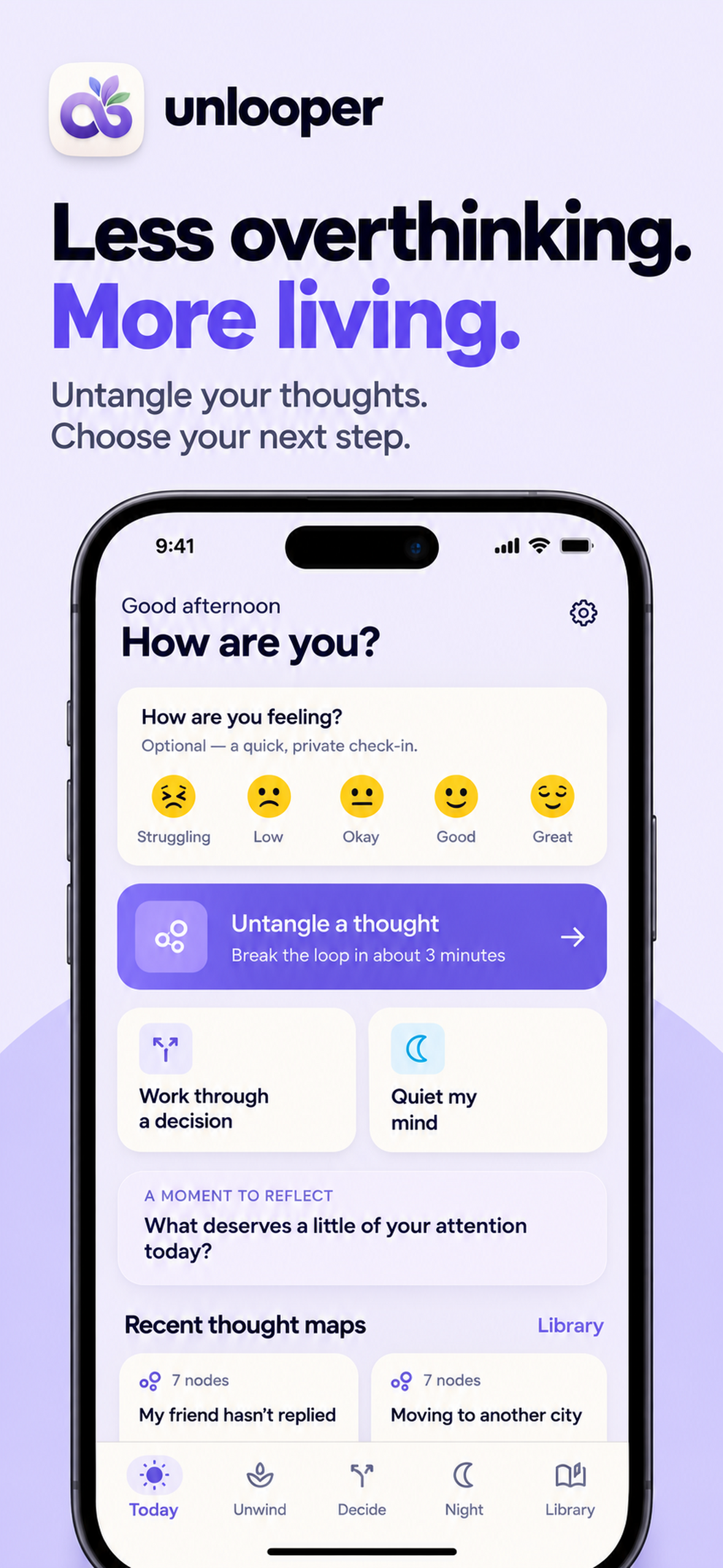
If several of these signs sound familiar, unLooper gives you structured tools for the moment a loop starts. The Overthinking Breaker is a guided session of about three minutes that separates fact from fear, finds other angles, and ends on one small doable step.
Daily mood check-ins and gentle progress tracking help you notice patterns, such as which days or times trigger the most overthinking. For nights, Quiet Mind at Night offers a bedtime brain-dump plus breathing and grounding. Decide for me helps with signs 2 and 11 by weighing options against what matters to you. Reflections stay private on your device, with no ads.
When to get help
If overthinking is persistent, disrupts your work, sleep, or relationships, or comes with thoughts of self-harm, please talk to a doctor or licensed mental-health professional. In the US, you can call or text 988 to reach the Suicide & Crisis Lifeline.
The bottom line
Recognizing the signs you are an overthinker is the first step, not the last. Pick the one or two that cost you most, apply the first step for each, and build from there. For a complete framework, read our guide on how to stop overthinking everything.
Frequently asked questions
What is chronic overthinking?
Chronic overthinking is a long-running habit of repetitive thinking that does not lead to decisions or action. It usually takes two forms: rumination about the past and worry about the future. It is a pattern, not a diagnosis.
Is overthinking a mental illness?
Overthinking itself is not a diagnosis. It is a common thinking pattern. However, research links persistent rumination to a higher risk of depressive and anxiety symptoms, so if it is constant and affecting your life, it is worth discussing with a professional.
What triggers overthinking?
Uncertainty, high stakes, fatigue, conflict, and unstructured quiet time, especially at night, are common triggers. Perfectionism and a strong fear of making mistakes also tend to fuel it.
Can an overthinker change?
Yes. Overthinking is a habit, and habits respond to practice. Techniques such as switching to concrete questions, scheduling a worry period, and ending every reflection with one small action can make loops shorter and less frequent.

Fahd Chouki is an independent developer and the founder of unLooper. He writes practical guides on overthinking, sleep and decision-making, summarizing published research into steps you can use the same day.
How we write: every guide is based on peer-reviewed research listed in the sources, reviewed for accuracy and updated when evidence changes.
Sources & further reading
- Nolen-Hoeksema, S. (2000). The role of rumination in depressive disorders and mixed anxiety/depressive symptoms. Journal of Abnormal Psychology, 109(3), 504–511. doi:10.1037/0021-843X.109.3.504
- Nolen-Hoeksema, S., Wisco, B. E., & Lyubomirsky, S. (2008). Rethinking rumination. Perspectives on Psychological Science, 3(5), 400–424. doi:10.1111/j.1745-6924.2008.00088.x
- Watkins, E. R. (2008). Constructive and unconstructive repetitive thought. Psychological Bulletin, 134(2), 163–206. doi:10.1037/0033-2909.134.2.163
- Harvey, A. G. (2002). A cognitive model of insomnia. Behaviour Research and Therapy, 40(8), 869–893. doi:10.1016/S0005-7967(01)00061-4
This article is for general information and self-reflection. It is not medical advice and does not replace a doctor or licensed mental-health professional.