How to Decide Between Two Options When Both Seem Good (or Both Seem Bad)
To decide between two options, compare them on the few criteria that matter most to you, weighted by importance. Then imagine each option failing, ask which you'd regret not trying in five years, and picture advising a friend. If they still tie, pick the more reversible one and commit.
Two job offers. Two apartments. Stay or go. When there are only two options, it should be simple, yet the closer they are, the harder it gets. You keep swinging back and forth, and every new thought tips the balance for about an hour.
This guide gives you six practical methods to decide between two options, with a full worked example and a template. Use one or combine several, depending on how big the decision is.
Why two options can be harder than ten
With many options, you can eliminate the weak ones quickly. With two good options, every advantage of one is a loss on the other. You're not choosing a winner; you're choosing what to give up.
That's why "pros and cons" lists often fail. Each side ends up with a similar number of points, and the list doesn't tell you which points matter more. The methods below fix that.
How to decide between two options: 6 methods
Method 1: The weighted score
Pick 3 to 5 criteria that truly matter for this decision. Give each a weight from 1 to 5. Score both options from 1 to 10 on each criterion, multiply by the weight and add up the totals.
Worked example: Apartment A (city center) vs. Apartment B (suburbs)
| Criterion | Weight | A score | A weighted | B score | B weighted |
|---|---|---|---|---|---|
| Rent affordability | 5 | 5 | 25 | 8 | 40 |
| Commute time | 4 | 9 | 36 | 5 | 20 |
| Space and light | 3 | 5 | 15 | 9 | 27 |
| Social life nearby | 3 | 9 | 27 | 4 | 12 |
| Quiet for sleep | 2 | 4 | 8 | 8 | 16 |
| Total | 111 | 115 |
Very close. That tells you something useful: both are reasonable, and the decision depends on your priorities. If commute or social life matters slightly more than you assumed, A wins. The score's real job is to show you exactly where the trade-off lies. For more on building this tool, see how to make a decision matrix.
Method 2: The double premortem
Imagine it's a year from now. You chose Option A, and it went badly. Write down why. Then do the same for Option B.
This is based on the "premortem" technique described by Gary Klein in a 2007 Harvard Business Review article: imagining a failure has already happened makes it easier to identify risks you'd otherwise overlook.
From the example:
- A failed because: "The rent stretched me so thin I couldn't save or travel."
- B failed because: "The long commute ate my evenings, and I stopped seeing friends."
Now ask: which failure would be harder to live with, and which could I more easily prevent? Maybe you could reduce B's risk with a remote-work day. If one option's failure is easier to manage, that's a strong tie-breaker.
Method 3: The regret test
Ask yourself: "In five years, which choice would I regret not making?"
In a 1995 review, Thomas Gilovich and Victoria Medvec found that people tend to regret actions more in the short term, but over the long term they tend to regret inactions more, the chances they didn't take. If one option is the bolder move you're drawn to but afraid of, the long-term view may favor it. If both are "actions", the test still helps you sense which one feels more like you.
Method 4: Advise a friend
Imagine a friend describes your exact situation to you, with the same two options. What would you tell them?
This works because of self-distancing. Research summarised by Ethan Kross and Ozlem Ayduk in 2011 found that viewing a situation from a more distant perspective, including thinking about it as if it were someone else's, tended to reduce emotional reactivity. From the outside, it's often clearer which factors matter and which are just noise. Write your advice down, then read it back to yourself.
Method 5: The coin flip (for your reaction)
Assign Option A to heads and Option B to tails. Flip a coin. You don't have to follow the result. Instead, notice your first reaction when it lands. A flash of relief or disappointment usually reveals which way you were already leaning.
Method 6: Choose the more reversible option
If everything else is tied, pick the option that's easier to undo or adjust. A one-year lease beats a purchase; a trial period beats a long contract. Reversibility lowers the cost of being wrong and lets you learn before committing further.
Common mistakes when choosing between two options
A few patterns make two-option decisions harder than they need to be:
- Counting pros and cons instead of weighing them. Five small advantages don't outweigh one major one. Weights fix this.
- Letting one vivid detail dominate. A beautiful kitchen or a charismatic interviewer can overshadow less exciting but more important factors like cost or workload. Return to your criteria.
- Comparing the real option with an imagined one. You know the flaws of your current job in detail, but the new one is mostly a story. Try to find out concrete facts about the unknown option, such as talking to someone who works there.
- Deciding while upset. Right after a bad day at work, leaving looks perfect. Score your options on a calm day, or at least sleep on the result.
- Reopening the decision every day. Set a deadline and stick to it. Close scores mean either option is reasonable, so extra days of thinking rarely change much.
Is there a third option?
Before you choose, check whether you're stuck in a false choice. Two-option decisions often hide alternatives:
- Delay: Can you wait a defined period for more information?
- Negotiate: Can you ask the new employer for a remote day, or the landlord for a lower rent?
- Combine: Can you take part of each, like a smaller place in a middle neighborhood?
- Test: Can you try one option briefly, such as staying near the suburban apartment for a weekend?
Sometimes the best answer to "A or B?" is "a better version of A".
A copy-and-use two-option template
``` OPTION A: __ OPTION B: __
-
WEIGHTED SCORE Criterion (weight 1–5) | A (1–10) | B (1–10) __ ( ) | | __ ( ) | | __ ( ) | | Totals: A _ B _
-
PREMORTEM A failed because: B failed because: Which failure could I prevent or live with more easily?
-
REGRET TEST In 5 years, which would I regret not choosing?
-
ADVICE TO A FRIEND I'd tell them to:
-
COIN FLIP REACTION Felt relief / disappointment when it landed on: ____
-
REVERSIBILITY Easier to undo: ____
THIRD OPTION? __
DECISION by (date): __ FIRST STEP: __ ```
Once you've decided
Commit with a specific first step and a date: "I'll sign the lease for Apartment B on Saturday." Then give the choice a fair trial before you reconsider. If doubt shows up afterwards, our guide on how to know if you made the right decision helps you judge the choice by your process rather than by early feelings. And if things don't go as hoped, read how to get over a bad decision.
If you're dealing with more than two options or feel completely stuck, our broader guide on how to make a decision when you can't decide offers a full seven-step method.
How unLooper can help
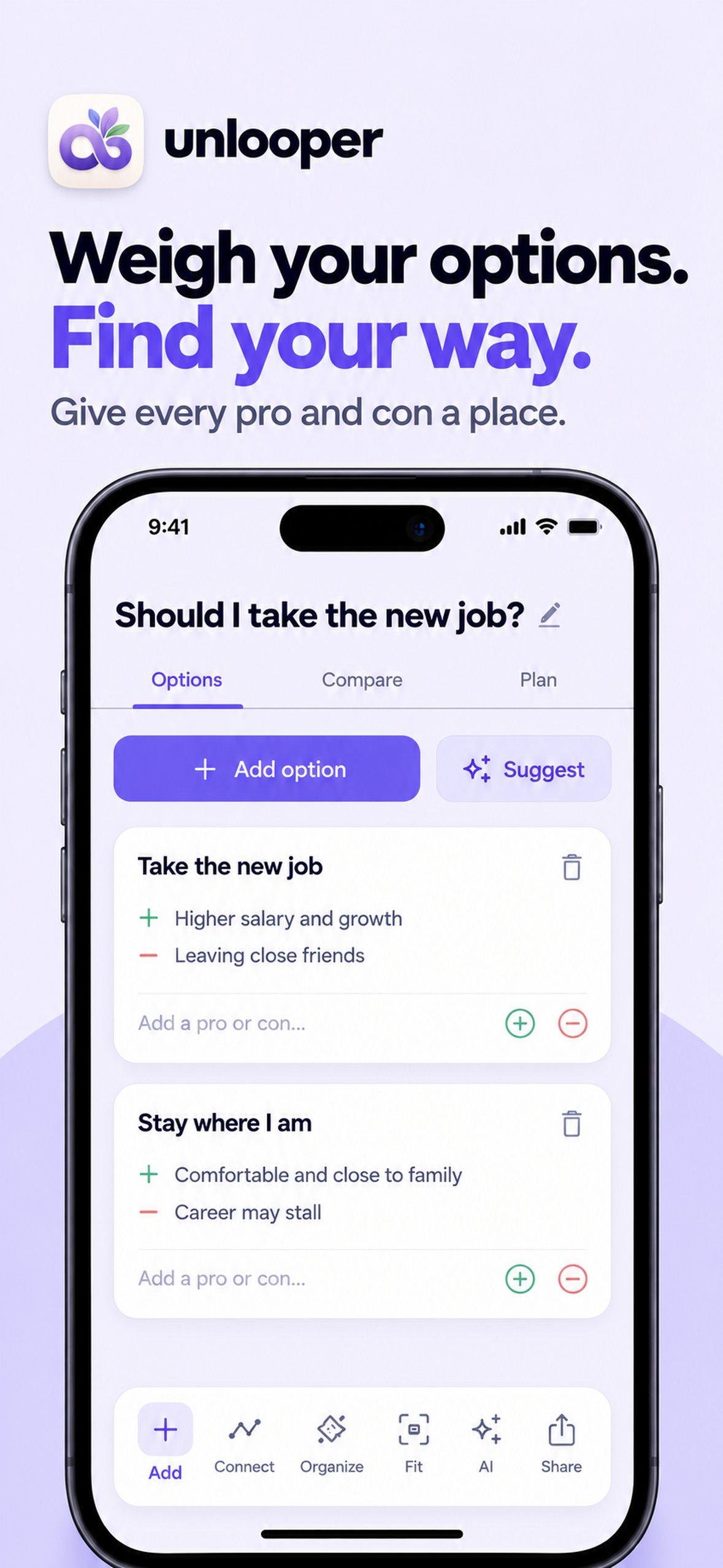
unLooper's Decide for me is built for exactly this kind of choice. You enter your two options and what matters to you, give each criterion a weight, and see how they compare. You then get an honest AI review of the trade-offs, a second opinion that can point out risks or angles you missed, and you make the final call.
If the decision is wrapped up in worry, the Overthinking Breaker, a guided session of about three minutes, can help you separate fact from fear first. Reflections are private by default and stay on your device, with no ads.
The bottom line
When you're torn between two options, stop flipping back and forth in your head. Score them on weighted criteria, imagine each one failing, ask which you'd regret not choosing, and picture advising a friend. If they're still tied, choose the more reversible option and commit. Close scores usually mean there's no wrong answer, just a choice to make and support.
Frequently asked questions
What do you do when you can't choose between two options?
Write down three to five criteria that matter, weight them, and score both options. If they're still close, use a tie-breaker such as the regret test, advice-to-a-friend, or choosing the more reversible option. Close scores usually mean either choice is reasonable.
Does flipping a coin help you decide?
A coin flip can help, not because you must follow it, but because of how you react. If you feel relief when it lands on one side, or disappointment, that reaction tells you which option you were already leaning toward.
How do I choose between two jobs?
List what matters most to you right now, such as pay, growth, stability, commute and team. Weight each one, score both jobs, and run a premortem on each. Talk to someone who works or has worked at the new company if you can, then set a deadline to decide.
What if both options are bad?
Check whether there is a third option you haven't considered, such as delaying, negotiating or combining parts of both. If not, choose the option whose downside you can best manage or recover from, and make a plan to reduce its main risk.

Fahd Chouki is an independent developer and the founder of unLooper. He writes practical guides on overthinking, sleep and decision-making, summarizing published research into steps you can use the same day.
How we write: every guide is based on peer-reviewed research listed in the sources, reviewed for accuracy and updated when evidence changes.
Sources & further reading
- Gilovich, T., & Medvec, V. H. (1995). The experience of regret: What, when, and why. Psychological Review, 102(2), 379–395. doi:10.1037/0033-295X.102.2.379
- Klein, G. (2007). Performing a project premortem. Harvard Business Review, 85(9), 18–19.
- Kross, E., & Ayduk, O. (2011). Making meaning out of negative experiences by self-distancing. Current Directions in Psychological Science, 20(3), 187–191. doi:10.1177/0963721411408883
This article is for general information and self-reflection. It is not medical advice and does not replace a doctor or licensed mental-health professional.